
Culture Co-Op ran a survey for the Broadway production company No Guarantees and buried a trap in it: among the real titles shown to 1,012 Gen Z and Millennial adults, they slipped in a handful of shows that do not exist.
Sixty percent said they were familiar with the fake ones.
Everything else in that study follows from the same gap. Eighty-four percent believed 20 or fewer shows were running on Broadway; there were 41. Nearly 40% didn't think they'd ever seen anything about live theater in their social feeds. Asked to estimate an average ticket, they guessed at least $200 — against a real average of $123, with plenty of seats at $49.
Read that as a rejection and you'll spend three seasons solving the wrong problem. It isn't a verdict on the art form. It's an audience deciding in the dark, filling the gaps with assumptions, and settling the question before your work is ever considered.
Which is the argument here, stated up front: for most arts organizations, the younger-audience problem is an information problem long before it is a pricing problem, and it is almost never a taste problem. The reflex when the room skews old is to change what happens on stage — the expensive intervention, the one that risks the audience you have, and the one the evidence supports least. Ask the cheaper question first: do younger people actually understand what we're offering?
What do younger audiences actually want from arts organizations?
Mostly, to know what is available. In the same research, half said what would most increase their interest in theater was simply knowing and hearing more about it. Then 91% reported being more interested in going after taking the survey — a survey with no budget, no creative and no offer. Just information, delivered to people who had none.
The most quietly radical number is 77%: the share who'd prefer Broadway stay Broadway and not change a thing. New work and new formats do bring in new people — but the picture of a generation demanding the art form be rebuilt is not what the research describes. Most just need a better introduction to what already exists.
There's a second trap in the phrase "younger audiences": Gen Z and Millennials are not one audience. A 24-year-old choosing between a gallery opening and drinks and a 38-year-old arranging childcare both land in the "under 40" bucket, sharing nothing that matters — not the motivation, the barrier, the timeline or the channel. The Wallace Foundation put it in a report title: Millennials Are Not a Monolith.
Denver Center Theatre Company got somewhere more useful building audiences for its adventurous Off-Center work: what its new attendees had in common wasn't a birth year. As one leader there put it: "They're not all 23, but that's okay. These are more adventurous shows, and an adventurous spirit doesn't have an age to it."
So stop asking only who is under 35. Ask who seeks out unusual experiences, who wants something social, who follows emerging artists — who attends three festivals a year and has never walked into your theater.
Age describes an audience. It shouldn't be the strategy. The build-out is in audience personas for arts organizations and audience segmentation; if you're still deciding who you're aiming at, start with how to identify your target audience.
Why does crossover programming so often disappoint?
Because it asks one event to do two jobs: pull in someone who wouldn't normally attend, then convert them into an audience for something else entirely. The first is achievable. The second doesn't happen on its own.
Researchers at the University of Texas at Austin spent seven years studying 25 large performing arts organizations funded by the Wallace Foundation's Building Audiences for Sustainability initiative. Their conclusion on crossover was blunt, and the National Endowment for the Arts led with it: organizations were repeatedly disappointed by how little crossover their crossover produced. The symphony collaborates with an indie band, fills the hall with a younger crowd, and watches almost none of them return for the season.
That doesn't make the concert a failure. It makes it a concert. Liking one experience does not create demand for a different one — treating an alternative series as a funnel into the mainstage is an assumption, not a plan. Use the guest artist, the unusual venue, the one-off, then do the part most organizations skip: work out what brought those people, what they'd want next, and how you'll stay in contact. That shift, from filling a room to building a following, is the argument in cultivating new audiences, not just selling more tickets. Programming opens the door. Audience development is everything after someone walks through it.
What actually stops a younger person from attending?
Cost — but not the cost you charge. The cost in their head. Those Broadway respondents priced the experience at $200 when the average was $123. They aren't declining your ticket. They're declining an imaginary ticket that costs roughly twice as much.
Which makes a discount the wrong instrument. If your seats genuinely cost more than your intended audience can pay, pricing strategy is the answer. But if a $35 ticket is imagined at $80, a 20% off code fixes nothing — it confirms the thing was expensive. Make the real lowest price impossible to miss.
And price is only the barrier people can articulate. Underneath sit awareness, scheduling, transport, everything competing for that evening — and the one arts organizations consistently underestimate: finding someone to go with.
A first-timer isn't only deciding whether they want a ticket. They're deciding whether they're willing to sell this to a friend — and that friend will ask what it is, how much, will we understand it, what do we wear. Every question your event page doesn't answer becomes one your attendee answers on your behalf, in a group chat, without your help.
It's why a two-for-one sometimes beats a deeper discount: it isn't a better price, it's a solution to the plus-one problem. But the cheapest diagnostic is one question:
Can a first-timer forward your event page to a friend without having to explain it?
Run it on your own listings this week. Precisely where a bare event listing stops working.
They are not price-sensitive. They are value-uncertain.
The assumption underneath most youth-pricing schemes is that younger people don't have money for live experiences. The evidence is more awkward: they have it, and they're spending it elsewhere. Luminate found Gen Z live-music attendees spending $101 a month on average in early 2026, ahead of Millennials at $94 — while the share naming ticket price as a barrier fell from 75% to 57% in two years, and the share attending two or more concerts a year climbed from 29% to 37%.
Put that beside an audience that systematically overestimates what arts tickets cost, and the diagnosis changes. They're not refusing to spend. They're unsure what they're getting for it. That's a value-communication problem wearing a pricing problem's clothes — and one with little to do with budget size, as marketing cultural events on a limited budget lays out.
Post the menu
Across the nearly $41 million in audience-building work Wallace funded and UT Austin analyzed through 2022, the most consistent through-line is unglamorous: the organizations that made progress became more welcoming, informative and responsive in how they communicated. One interviewee framed it as a question that belongs above every marketing desk:
"Who would go to a new restaurant without checking online to see what the experience was going to be? And we realized that from the consumers' perspective, they're thinking about the theater in the same way."
So post the menu. What it costs, how long it runs, what happens, what the room feels like, what to know before arriving. All of it reads as unnecessary to the five people approving the event page — because all five already know the organization. The newcomer knows none of it.
The same research found insider shorthand doing real damage: audiences were confused by "mixed rep," and describing a work as "non-narrative" helped no one. That organization concluded it had to stop explaining what a production isn't and start conveying what it is. Not dumbing down the art — removing the requirement that someone understand your institution before they're allowed to be interested in it, the posture shift at the centre of rethinking the nonprofit marketing mindset.
Then the half most organizations never reach: show how the thing is made. Culture Co-Op's 2025 follow-up found what respondents were willing to pay more than tripled once they saw what goes into staging a production. A poster shows the finished product; a rehearsal shows the work, a costume fitting shows craft, a dancer repeating one passage forty times shows exactly what the ticket buys. Explaining your price is defensive. Showing the work is persuasive.
What posting the menu actually looks like
Every event page should answer these without a click:
The lowest real ticket price. Visible, not discoverable at checkout.
Run time. People are planning an evening, not buying a seat.
What happens. Written for someone with no prior knowledge.
What the room feels like. Atmosphere, dress, seating, whether there's a bar.
How it's made. Rehearsal, artists, sets, costumes — this is what builds value.
None of this needs a budget. It needs a decision: the person who knows nothing is the reader you're writing for.
Let people sample the work and get a feel for the room
Every other entertainment category lets you sample before committing: music streams, films have trailers, games have demos. Arts organizations ask a stranger for $70 and an evening on the strength of a title and a poster — and the audience has already worked around us. OPERA America's national study with Slover Linett and NORC at the University of Chicago, covering 11,000 ticket buyers across 36 companies, found many new-to-opera attendees listen to and watch recordings before they ever attend in person. People want a little of the experience before they buy the whole experience.
Direct access to the work is, in our view, the most under-built asset in arts marketing. Thirty seconds of the music. A rehearsal clip. An actor doing part of a scene. Not another polished trailer asserting the event will be extraordinary — let people hear why. A thirty-second clip of the players, the gallery, or the room before curtain answers four questions at once: will I understand it, what does the place actually feel like, is it worth the money, will my friend come.
How should arts organizations reach younger audiences?
Start by separating discovery from conversion — most marketing plans quietly assume they're the same job, a distinction worth reading in full in event discovery vs. event promotion.
Email is where this gets confused. It works well on people who already know you — a retention channel wearing an acquisition channel's job title. Rival Technologies found heavy email fatigue among Gen Z and Millennials, including 31% sitting on more than 1,000 unread messages. Keep sending it; just be honest that it cannot reach someone who never joined your list.
SMS is valuable for one reason — people read it almost immediately — which is exactly why it shouldn't become a second newsletter. Use it for reminders, last-minute availability and anything with a real closing window.
Fever's research found word of mouth to be the primary discovery mechanism for classical, with social a powerful entry point. That matches how these decisions run: someone sees a rehearsal clip on Instagram, lands on the event page, sends it to a friend, and buys when a reminder arrives days later. Three channels, three jobs — and the middle one is where campaigns leak. No amount of reach compensates for an event page that leaves someone unsure what they're buying. If you're layering paid campaigns on top, get the page right first — mechanics in how to build ads that actually sell tickets.
Your building might be the barrier, not your programming
Fever's Classical Pulse 2026 study of 8,000 people across ten countries found classical being redefined for younger listeners by immersive formats and unconventional venues — settings institutions file under "less prestigious" and first-timers often experience as the best part. Urban Institute research goes further: three of the four places people most often encounter arts and culture aren't arts venues at all — parks and streets, schools and colleges, places of worship. Concert halls were the only conventional venue in the top four, and among organizations that tried presenting work somewhere new, 85% increased participation.
The sector files this under outreach, which undersells it badly. It's distribution. If people already meet art in community spaces, showing up there isn't bringing the institution outward — it's putting the work where the audience already is.
That opens up smaller concerts, outdoor programming, neighborhood events and pop-ups, often with partners who already hold those rooms — the approach mapped in the theater partnership playbook. The prestige of the main hall may matter enormously to your existing audience; to a first-timer it's the intimidating option. Nobody is saying abandon your building — only that requiring every relationship to begin inside it is a limit you chose.
How do you protect your existing audience while doing it?
By noticing that almost nobody is asking you to trade one for the other. Keep the anchor: maintain the familiar, important work and introduce new artists and interpretations around it — remembering that 77% of those Broadway respondents would rather it not change at all.
Honor the people already there. Longtime audiences rarely object to new people arriving. What they object to, reasonably, is communication implying their loyalty is a demographic problem to solve.
Then segment the marketing. The message reassuring a 27-year-old first-timer that they won't be underdressed is noise to a 20-year subscriber — it wasn't written for them. This is where audience development strategies for arts organizations stop being theory: different audiences get different invitations into the same organization, and neither has to watch you talk to the other.
How do you measure whether it's working?
Not by whether one room looked younger — that's a photograph, not a metric. Track:
Age mix of new buyers, not of the room
Return rate of younger first-timers — the number that decides this
Core-audience retention, so you can see the trade-off if there is one
Which channels and entry points produced new attendees
Whether younger participation spreads or stays quarantined in one event
The gap between attendance and return is where most youth initiatives quietly die: a special program can pull hundreds of younger people through the door and change your audience by exactly nothing. The framework is in what audience data arts organizations should track, the follow-through in arts audience retention: how to earn the second visit.
So name the trap: a young-audience program can fill a room, report excellent numbers and build no audience whatsoever. The test is afterward — can you identify who attended, do you know why they came, did you contact them again, are they still in your data a year later. If there was no follow-up, you produced attendance. That can be worthwhile; it just isn't audience building, and calling it that is how organizations repeat the same successful initiative for six years while the room keeps aging.
How CultureOwl fits in
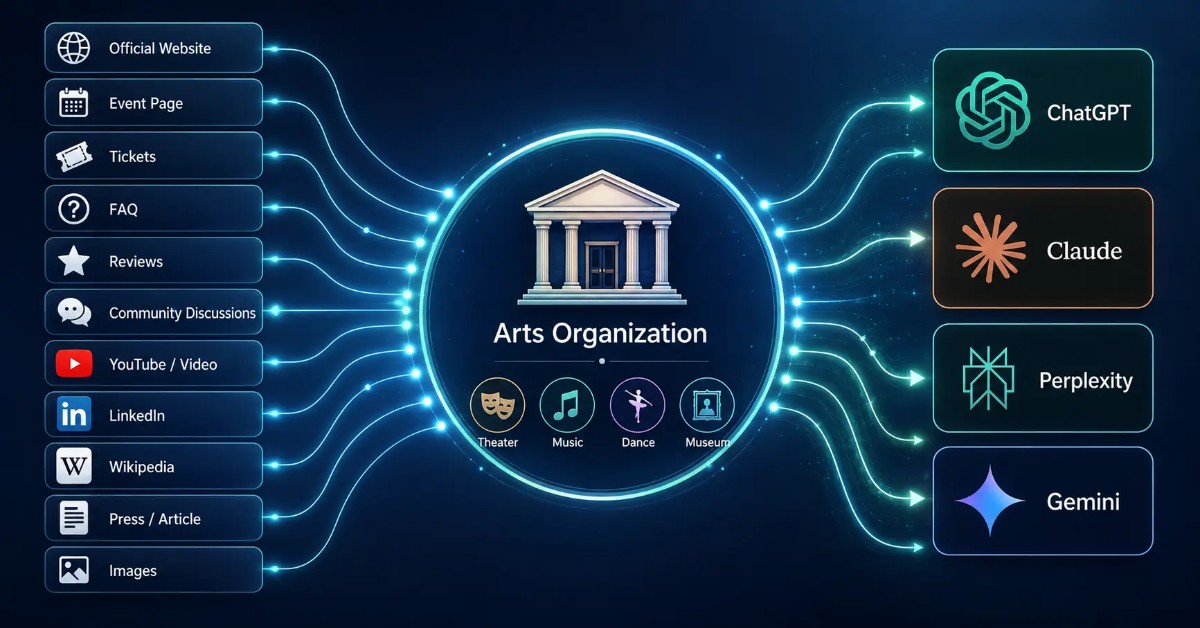
Every strategy above hits a wall no single organization can clear alone. The sector treats discovery as a marketing function. It's actually infrastructure.
A theater can market its theater. An orchestra can promote its concerts. A museum can promote its exhibitions. Not one of them can become the place where a city browses theater, music, museums, dance and festivals because someone simply wanted something interesting to do on Friday. That layer has to be shared, or it doesn't exist — which is what we mean by discovery that compounds rather than another listings page.
On CultureOwl, people browse by interest, location and experience without knowing which institution to search for first. For organizations that means curated discovery rather than a listings dump, event pages that answer the price and what-to-expect questions instead of hiding them, room to show the work through imagery and video, and promotion and ticketing that connect discovery to attendance and the return visit.
We're a Public Benefit Corporation because culture is a public good, and the infrastructure under cultural discovery ought to strengthen the organizations creating it rather than tax them. No single theater, orchestra or museum should have to solve the same citywide discovery problem alone — or depend on platforms where visibility is decided by an algorithm, or by whoever spends most that quarter.
More on how we support that through event promotion, audience growth and ticketing for arts organizations.
The bottom line
Sixty percent of younger respondents recognized Broadway shows that had never been written. That's the scale of the information problem — and the most encouraging finding here, because information is the cheapest thing to fix. People decide against arts experiences with enormous gaps in what they know. You don't close those gaps by changing the art. You close them by making the art easier to encounter.
Post the menu. Show the work. Let people sample it. Make the event easy to send to a friend. Reach people where discovery actually happens. Keep the anchors your existing audience values. Then measure whether the first visit becomes a second.
The goal was never to make the room look younger for one night. It's to make art and culture easier to discover, understand and choose — so younger audiences have a reason to come through the door and, eventually, to come back.
For your discipline: opera, theaters, orchestras and museums. For the wider playbook, start with how to market arts and cultural events, the theater marketing guide or how to market an opera company.