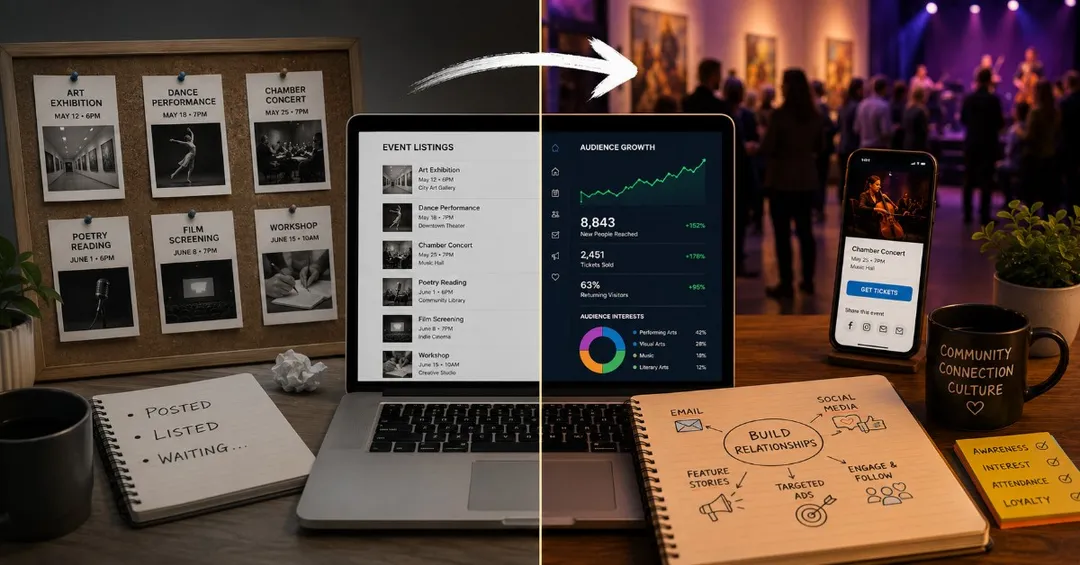
Listings fix the wrong problem. Culture Track found the second-biggest barrier to cultural participation is "I didn't think of it," and TRG Arts reports that churn among new single-ticket buyers has risen from 75% to 85%. This piece looks at how audiences actually find events, why search is sending fewer of them to event pages, and what the evidence says about turning a first visit into a second.
Every organization already publishes everywhere it can: its own site, its ticketing system, local calendars, tourism directories, social channels. On paper, the event is available. The data on attendance suggests availability was never the constraint.
TRG Arts' benchmark data shows that, sector-wide, 66% of audience members in a given season are first-time patrons. The field brings in new people at volume. What it struggles to do is bring them back. In 2024 TRG reported that new single-ticket and admission churn, historically around 75%, has climbed to 85%. More listings, more channels, and more first-time buyers have not added up to bigger audiences.
The barrier a listing can't remove
Culture Track '17, LaPlaca Cohen's national survey of 4,035 U.S. cultural participants, ranked the barriers to participation. First was the feeling that an activity is "not for someone like me." Second was "I didn't think of it." Both ranked above inconvenience, having no one to go with, and cost.
Neither barrier is about missing information. A listing answers "when and where" for someone who is already looking. It does nothing for the person who never thought to look, and nothing to reassure someone who suspects the event isn't meant for them.
The National Endowment for the Arts measured that missed audience directly. In When Going Gets Tough (2015, based on the 2012 General Social Survey), 13.3% of U.S. adults, about one in seven, were "interested non-attendees": people who wanted to go to a specific exhibit or performance in the past year and didn't. Their reasons:
Couldn't find the time: 47%
Cost too much: 38%
Too difficult to get there: 37%
Couldn't find anyone to go with: 22%
The same report found that socializing with friends or family was the most common motivation for attending (73% of attendees). Taken together, those findings frame the job. Interest already exists. What it needs is an occasion, a companion, and a moment when the event comes to mind. Those are discovery problems, and a listing doesn't solve them.
How people actually first hear about an event
The 2022 Survey of Public Participation in the Arts asked U.S. adults how they first learned about an arts event they ultimately attended. Social media came first at 17.0%. Next were friends, neighbors, or coworkers (14.7%), then print or broadcast media (11.3%), with partners or spouses and other family members at 8.0% each. Just under half of adults (48%) attended any arts event in person that year, down six points from 2017.
Australia's Audience Outlook Monitor (October 2022, Patternmakers and WolfBrown, n=4,031) asked recent attendees the same question and got a different answer. Direct emails from arts organizations led at 57%, then websites (50%) and word of mouth (40%). Among people 75 and older, 67% heard by email. Among under-35s, websites (59%) and word of mouth (57%) came before email (43%).
The difference between the two surveys is the point. Ask existing audiences and email leads, because email only reaches people already in the database. Ask the general population and the routes that matter are social feeds and other people. Owned channels show up strongly in reporting because the people they reach have already found you. That makes them a measure of retention, and a weak signal of acquisition.
The mechanics of reaching people outside the database are covered in Event Discovery vs. Event Promotion: What Arts Organizations Need, and the case for organizations pooling that reach is made in Discovery That Compounds.
Search is sending fewer people to the page
The traditional fallback was search: someone types a query and the event page ranks. That path is narrowing. Pew Research Center analyzed the March 2025 browsing data of 900 U.S. adults. When a Google search showed an AI summary, users clicked a traditional result in 8% of visits, compared with 15% when there was no summary. They clicked a link inside the summary in 1% of visits.
For an event page, that means the answer, and sometimes the recommendation, increasingly appears before anyone reaches your site. Being findable now depends on being well represented in the sources search and AI tools draw from, not only on having a page. AEO for Arts Organizations covers what that requires in practice.
What moves a stranger from interest to purchase
The largest recent test of audience-building tactics is the Wallace Foundation's Building Audiences for Sustainability initiative. It granted nearly $41 million to 25 performing arts organizations between 2015 and 2019, and the University of Texas at Austin evaluated the results, published in 2024 as In Search of the Magic Bullet. Two findings bear directly on how events are presented:
Telling audiences what to expect worked; the usual labels didn't. One organization learned that "world premieres" held little cachet for the audience it was trying to reach. Giving prospective attendees a sense of what the performance would be like had a real effect.
Delivering that content digitally helped. The report found that expanding the use of email, social media, and video to share informative content was consistently effective.
A typical listing holds title, artists, venue, date, and price, written by people who already know the work. Wallace's evidence suggests that is the least persuasive layer for a newcomer. What converts is context: what the evening is like, who it is for, and what happens when you arrive.
Context also costs money to distribute, which is where promotion comes in. Discovery is the ongoing opportunity to be found. Promotion buys concentrated attention for a specific event in a specific window, and it pays off most where recognition is lowest, such as new work, unfamiliar disciplines, or short runs. For allocating a limited budget across those choices, see How to Market Cultural Events With a Limited Budget.
Acquisition without a second visit is a treadmill
The same Wallace evaluation found that attracting new target-audience members was more readily achieved than engaging them as frequent attendees. Ten of the 15 organizations in the outcomes study grew their target audience, though usually by less than they had hoped. Many saw more people attending, but attending less often. By the end, some participants were openly questioning what one called "this old myth of the long slow escalator," the assumption that first-time buyers naturally progress to subscribers and then donors.
Philadelphia Ballet shows what that looks like at the level of one organization. Its marketing director told TRG Arts that the company's churn runs at about 40 to 50%, well below the sector benchmark, yet it still needs to attract roughly 25,000 to 30,000 new ticket buyers every year.
The return on fixing this is well documented. TRG's study of 113 client organizations found that a new buyer persuaded to return within a year of the first visit is twice as likely to stay over the long term. TRG's more recent work notes that first-timers can take 18 to 24 months to come back. That is a long gap for an event page that stops being useful the night the run ends.
Arts Audience Retention: How to Earn the Second Visit and Audience Development Strategies for Arts Organizations cover the follow-up in detail.
Who keeps the relationship
All of the retention evidence assumes the organization can reach its new buyers again. That depends on the platform where the sale happened. Ask any ticketing or listing platform two things:
Can we access the information of our own buyers, subject to their permissions and privacy rules, or does the platform keep it?
Does an event lead somewhere after the date passes, such as an organization page people can follow, or does it end at "event ended"?
If the answer to either is no, the platform can produce transactions while the organization still has an 85% churn problem it cannot act on. A platform's broader audience helps with acquisition. Your own buyer data is what makes retention possible, and tracking what brings people back shows whether it is working.
How CultureOwl fits in
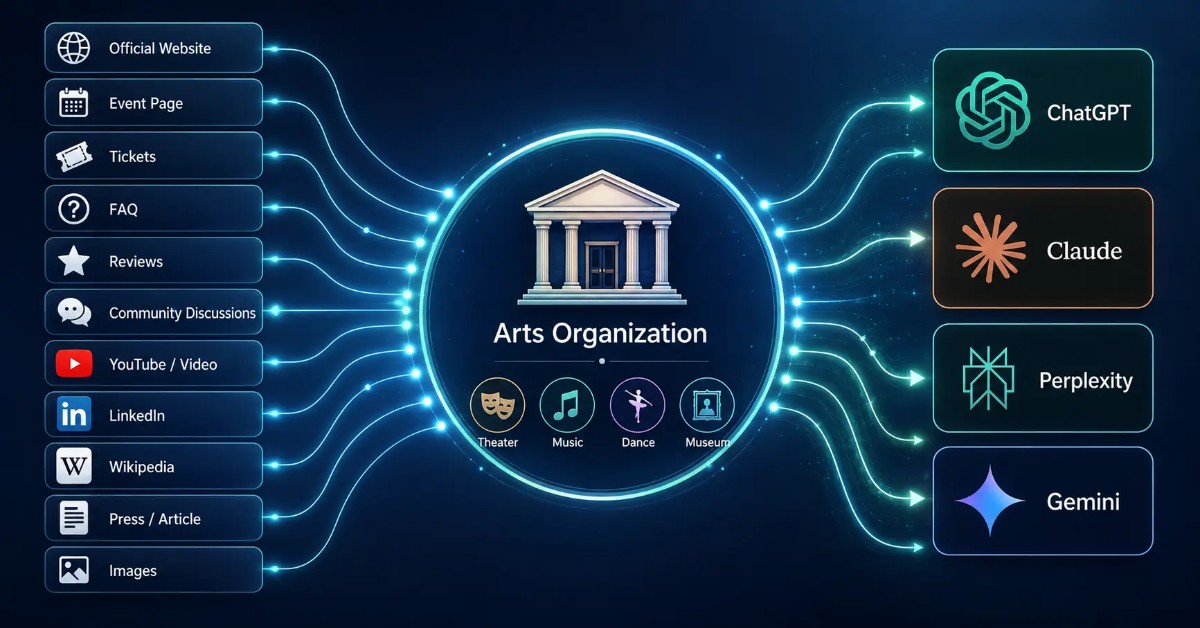
The evidence points to two gaps: people who never think of an event, and first-time buyers no one brings back. CultureOwl is event discovery with low-cost ticketing, built for the arts. People browse it across multiple markets before they know which organization they want, and every event leads to an organization page they can follow. Priority events can get added reach through event promotion, and members selling through CultureOwl can access their own buyers' information, subject to permissions. It operates as a public benefit corporation. More on audience growth.
Frequently asked questions
Why don't event listings increase attendance on their own?
A listing helps people who are already looking. Culture Track '17 found that "I didn't think of it" was the second most common barrier to cultural participation, after "not for someone like me." A published event does nothing for people who never think to look for it.
How do people first hear about arts events?
In the NEA's 2022 Survey of Public Participation in the Arts, U.S. adults most often first learned about an arts event they attended through social media (17.0%), followed by friends, neighbors, or coworkers (14.7%). Surveys of existing audiences rank organizational email higher, because email reaches people already in the database.
What share of first-time arts buyers come back?
Not many. TRG Arts reports that 66% of a typical season's audience are first-time patrons, and that churn among new single-ticket buyers has risen from about 75% to 85%. Buyers who return within a year are twice as likely to stay long term.
How is AI search changing event discovery?
Pew Research Center found that Google users clicked a traditional search result in 8% of visits when an AI summary appeared, compared with 15% without one. Fewer searchers reach the event page itself, so being represented in the sources AI draws from matters more.
Key takeaway
The constraint on audience growth isn't publishing. Most organizations already bring in large numbers of first-time buyers and then lose most of them. The evidence points to three levers: reaching interested people who weren't thinking about you (discovery), giving newcomers enough context to commit (content and targeted promotion), and keeping a direct line to every buyer so a second visit happens within the year. A listing provides none of these on its own.