
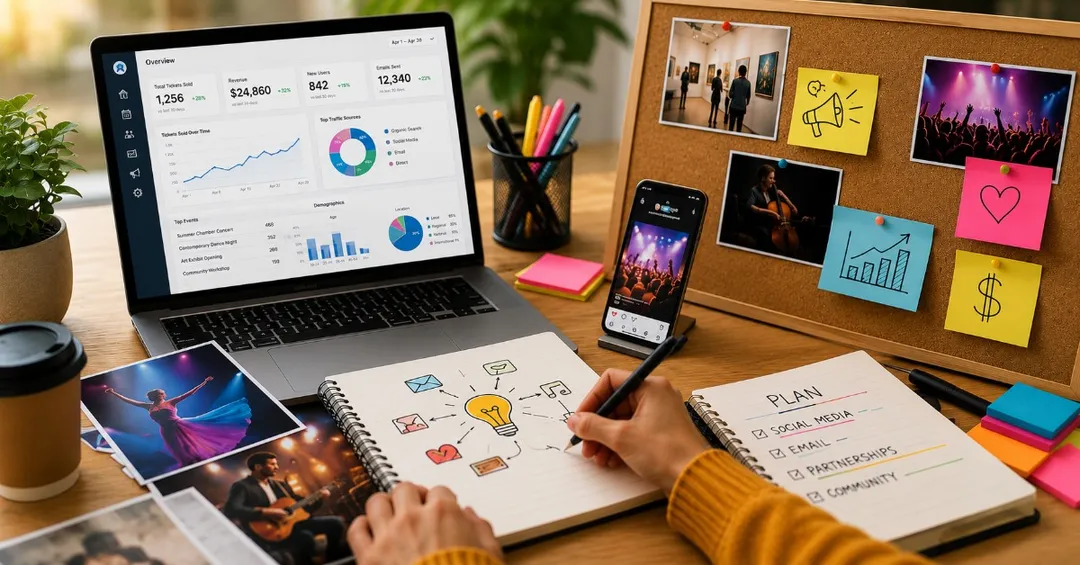
A small marketing budget is most at risk in two places: ad spend split too thinly for the platform to optimize, and first-time buyers who never come back. Meta says an ad set usually exits its learning phase after about 50 results in the week after its last significant edit, and TRG Arts reports that churn among new single-ticket buyers has risen from 75% to 85%. This guide covers where limited money and staff time do the most work, and where they leak.
Most advice on low-budget event marketing is a list of free tactics. The trouble is that a long list is itself the problem. A team that posts daily, sends three versions of the same email, lists the event on every calendar, prints flyers, pitches the press, and boosts a few posts is busy, but no single channel gets enough weight to produce a result or a readable signal.
The evidence below points the other way: fewer audiences, fewer channels, more concentration, and more attention to what happens after the first purchase.
The acquisition math has changed
TRG Arts reported in 2024 that, in its North American data, 50% of arts audiences are now new, up from 43% before the pandemic. On its face that is good news. The same report found that churn among new single-ticket and admission buyers has risen from 75% to 85%.
For a small organization, that combination changes what a limited budget is for. Getting new people through the door is working better than it was. Keeping them is working worse. Every campaign that brings in first-timers and then sends them nothing relevant is paying acquisition costs on buyers it will mostly have to acquire again.
That is the frame for every decision below: spend to reach people who are likely to come, and spend staff time making sure a first visit has a next step.
Set a goal narrow enough to decide the budget
"Promote the event" can't allocate money. A goal that names the audience, the action, the deadline, and the volume can:
Sell 150 tickets to first-time buyers within a 20-mile radius before opening night.
That goal rules things out. It makes the existing email list a secondary channel (those people are not first-time buyers), makes geography a targeting constraint, and defines the one number the campaign is judged on.
The goal also tells you where the first dollar goes. The diagnosis is usually one of four:
Too few people reach the event page: the problem is discovery, so money goes to partner distribution, discovery platforms, or targeted promotion.
People visit but don't buy: the problem is the page, the offer, or checkout, and more traffic will make it more expensive, not better.
Existing supporters respond but new audiences don't: the event is sitting only in owned channels, which by definition reach people who already know you.
First-timers come once and disappear: the problem is follow-up, and given the churn figures above, it is often the most valuable one to fix.
Concentrate paid spend, because the algorithm needs volume
The case for concentration is not just strategic preference. It is how the platforms work.
Meta's Business Help Center says an ad set exits the learning phase when it can deliver stably, which usually occurs after about 50 results in the week after the ad set's last significant edit. Until then, delivery and cost per result are unstable.
A small budget spread across several ad sets, each optimizing for ticket purchases, will rarely reach that threshold. An ad set producing ten sales a week stays in learning indefinitely, and every significant edit restarts the clock. The practical options are trade-offs:
Consolidate into one or two ad sets so results pool rather than split.
Widen the audience so the system has more room to find buyers.
Optimize for an event that happens more often, such as landing page views, accepting that the system is now optimizing further from the sale.
Run fewer, longer campaigns on priority events rather than a little spend behind every event.
For a small organization, the honest reading is that early paid spend buys information rather than proof. Treat a few hundred dollars as a test of message and audience, and judge it on qualified visits to the event page and on new buyers in your own ticketing data, not on reactions or video views. The structure, creative, and benchmark data are covered in detail in how to build ads that actually sell tickets.
Choose the audience before the channel
Small teams often start with the channel question: Instagram or email, Google or flyers. The channel follows from the audience, and a useful audience definition is behavioral rather than demographic.
"Adults ages 25 to 45" gives a campaign nowhere to go. "Adults nearby who attend independent film and live music, are open to theater, and want social evenings that feel less routine" does. It suggests where they look (film and music listings, local culture newsletters, discovery platforms), what creative works (artist-led video, a clear sense of the evening), and what the event page needs to settle (what it's like, who it's for, whether they'll feel comfortable).
The most convertible newcomer tends to be someone already attending adjacent art forms, which is why cross-promotion with organizations whose audiences overlap tends to outperform broad targeting. The methods for building these definitions are in audience segmentation for arts organizations.
Discovery before publishing
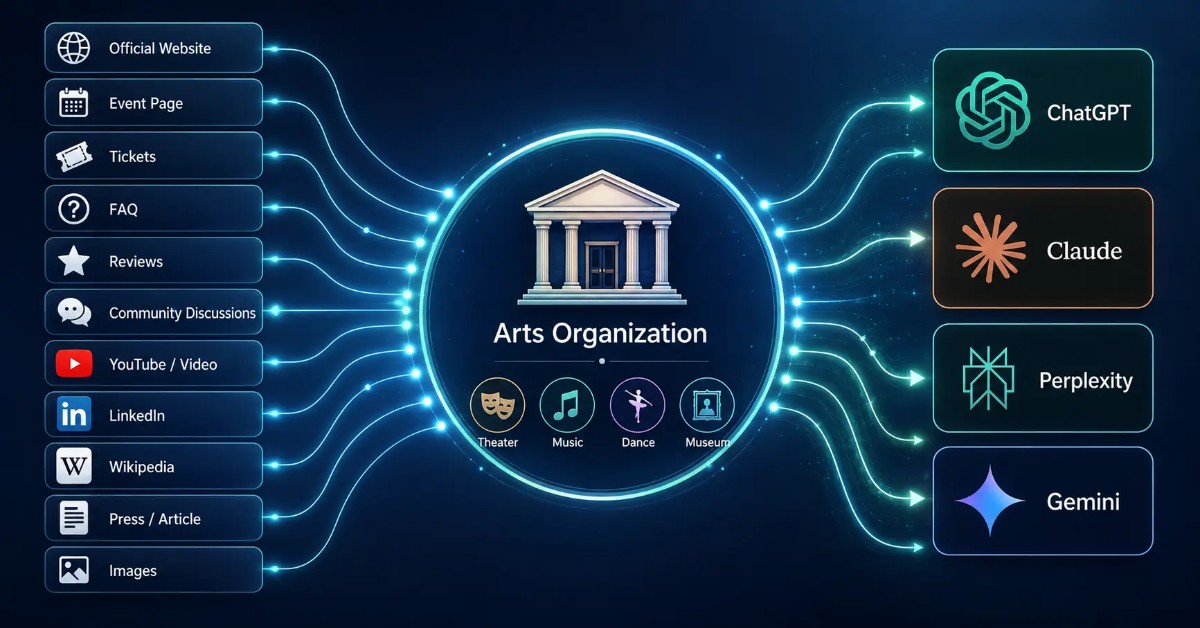
Owned channels (website, email, social, members, past buyers) reach a finite group who largely know the organization already. Growth requires being present where people are actively looking for something to do.
Being listed is not the same as being found. As covered in why event listings alone do not create audience growth, an event can be publicly available and practically invisible. Three questions sort useful outlets from noise: does the channel have an active audience, is that audience relevant, and do people use it with the intention of choosing something to attend? Someone browsing for cultural events this weekend is worth more than a general impression from someone with no plan to go out.
The difference between being discoverable and being promoted, and when each is worth paying for, is set out in event discovery vs. event promotion.
One idea, carried everywhere
Most cultural events carry more ideas than one campaign can hold: the artist, the subject, the history, the community connection, the mission. Communicating all of them produces a vague invitation.
Choose one reason to attend (a rare opportunity, a remarkable artist, a local story, a welcoming introduction to an unfamiliar form) and carry it across the event page, email, social, ads, partner material, and press outreach. Consistency is what makes a small campaign feel larger. Every encounter reinforces the same impression rather than starting over.
The same discipline cuts production costs. One artist interview can supply a web article, an email section, three social posts, a short video, a media pitch, partner copy, and an ad quote. One rehearsal visit can supply a campaign's photography. Building a sequence (introduction, context, what the experience is like, reminder, decision) from one story is cheaper and more effective than a week of countdown graphics.
Owned channels: relevance over reach
Email remains the cheapest channel most organizations have, and it is most effective when it is selective. Even basic segmentation (past buyers of a discipline, members, families, lapsed attenders) beats sending every announcement to everyone. Organic social is best used to make the event legible (scale, atmosphere, process, audience energy) rather than to drive purchases directly, and it largely reaches people already close to the organization.
Neither solves acquisition on its own. Their job in a limited-budget campaign is to convert people who already have intent, so paid and partner effort can go to people who don't yet know you.
Partnerships and word of mouth transfer trust
Partnerships are often described as free marketing. They cost relationship time and need a credible reason for the partner to care. A generic request to "share our event" is easy to ignore. A specific one (one newsletter inclusion, one group invitation, a partner offer) with ready-to-use assets is not.
What partners and personal advocates provide that paid media can't is trust: the recommendation comes from someone the audience already listens to. Artists, board members, staff, volunteers, and past attendees all have networks, and they share more readily when given something worth passing on, such as a story, a preview, or a reason the event is unusual, rather than a promotional graphic.
Fix the event page before buying traffic
Paid media amplifies a page. It cannot fix one. If traffic is healthy and sales are weak, the problem is positioning, information, price presentation, or checkout, not reach.
Price presentation now carries a regulatory dimension. The FTC's Rule on Unfair or Deceptive Fees, effective May 12, 2025, requires businesses that offer, display, or advertise live-event tickets in the US to show the total price, including all mandatory fees, upfront. Showing a base price and adding fees at checkout is no longer just a conversion risk.
It was already a conversion risk. Baymard Institute's checkout research consistently finds that extra costs (shipping, tax, and fees) are the most common reason US online shoppers abandon a purchase. That research covers ecommerce broadly rather than ticketing, but the mechanism is the same: a price that grows at checkout loses buyers who had already decided.
Beyond price, the page should settle what a newcomer needs to decide without searching elsewhere: what the experience is, run time, age guidance, accessibility, venue, parking or transit, seating, and who is presenting it, with a purchase path that works on a phone.
Measure enough to make the next decision
A small organization doesn't need a full attribution system. It needs to know where attention comes from and where the process breaks:
Traffic source for the event page, via tagged links on every email, partner post, and ad
Event-page conversion rate
First-time buyers as a share of the total, matched in the ticketing system rather than read from ad platforms
Sales pace against the goal
Second purchases from first-timers, the number the TRG churn figures say matters most
Read them diagnostically. Low traffic with strong conversion means the event needs discovery. High traffic with weak conversion points to the page, offer, or checkout. Strong social engagement with few site visits means the content is interesting but has no clear next step. A campaign that brings in first-timers and creates no ongoing connection is succeeding at promotion and failing at audience development. The full tracking setup is in what audience data arts organizations should track.
Make every campaign fund the next one
At 85% churn among new single-ticket buyers, the most expensive habit in event marketing is rebuilding the audience from zero each time. The follow-up after a first visit (a relevant next recommendation based on what the person attended, an invitation to follow or subscribe, a reason to bring a friend) is where the acquisition spend is either kept or lost. The specifics are in how to earn the second visit, and the longer path from first attendance to repeat participation is in audience development strategies for arts organizations.
That follow-up depends on having the buyer's contact details. When evaluating any sales channel, the full economics include not only what it costs to acquire the buyer and complete the sale, but whether the organization can reach that person again afterward. A sale that leaves the relationship with a third party has to be paid for again next season.
How CultureOwl fits in
The evidence favors concentrating spend and keeping first-time buyers. CultureOwl is event discovery with low-cost ticketing, built for the arts. People browse it across multiple markets to find something to do, so member events reach culture lovers beyond the organization's own channels. Priority events can get added visibility through event promotion, and members selling through CultureOwl can access their own buyers' information, subject to permissions, so a first visit can become a relationship. As a public benefit corporation, CultureOwl builds for the ecosystem's long-term health. More on audience growth.
Key takeaway
With a limited budget, concentration beats coverage. Platforms like Meta need volume (about 50 results a week per ad set) to optimize, so a small budget split many ways buys instability. TRG Arts' finding that 85% of new single-ticket buyers don't return means follow-up is often the highest-return use of staff time. Choose one audience and one reason to attend, put the event where people are already looking, show the full price upfront, and make sure every first visit has a next step.
Frequently asked questions
How do you market a cultural event with almost no budget?
Concentrate on one audience and one reason to attend. Use owned channels for people who already have intent, specific partner requests and discovery platforms to reach new people, and a complete event page that shows the total price upfront. Put remaining staff time into following up with first-time buyers.
Where should a small arts marketing budget go first?
Diagnose before spending. If too few people reach the event page, invest in discovery or targeted promotion. If people visit but don't buy, fix the page, offer, or checkout first, because more traffic won't solve a conversion problem.
Why do small Meta ad budgets underperform?
Meta says ad sets usually exit the learning phase after about 50 results in the week after their last significant edit. Small budgets split across several ad sets rarely reach that, so consolidating ad sets or optimizing for a more frequent event usually produces steadier results.
How can arts organizations tell if a low-budget campaign worked?
Set one measurable goal before launch, such as a number of first-time buyers, and track tagged links and purchase sources in your own ticketing data. Then track how many of those first-timers buy again, since TRG Arts puts churn among new single-ticket buyers at 85%.