Most arts organizations are not short of first-time buyers; they are short of second visits. TRG Arts' sector benchmark puts first-timers at 66% of ticket buyers, yet only about 25% ever buy again. This guide frames arts marketing as four jobs (be found, be understood, be chosen, be repeated), looks at where per-production campaigns lose value, and sets out the metrics that show whether marketing is compounding.
Why does arts marketing often fail to compound?
The issue is often structural rather than a question of budget or skill. When each production, exhibition, or festival gets its own campaign and the visibility built for it ends with the run, the next show starts from roughly the same place, at roughly the same cost.
The data shows what that costs. TRG Arts reports that, industry-wide, 66% of all ticket buyers are first-timers, but only about 25% of them will ever come back to buy a second ticket. UK data from Spektrix tells the same story: of audience members who first bought tickets in 2022, 19.5% returned in 2023, and Spektrix described that as the best retention rate since 2016. An organization in that position is effectively re-buying most of its audience every season. Event-by-event campaigns are built to sell one event, so they tend not to leave much behind to change that. That points to one question to ask of every campaign: did this leave anything behind?
What are the four jobs of arts marketing?
Separating the work into four jobs makes it easier to see which one is underperforming before money goes into channels:
Be found by people who weren't looking for you, and who may not have considered your art form at all.
Be understood in about one screen by someone who doesn't know the title, composer, choreographer, or company.
Be chosen over everything else on offer in the city that night, much of it cheaper and lower-commitment.
Be repeated, so a first-time attender has a specific, easy reason to come back while the experience is still fresh.
The fourth job is the only one that compounds directly, and given the retention figures above, it is usually where the largest gap sits.
Where per-event campaigns lose value
Three patterns keep coming up, and none of them depends on budget size:
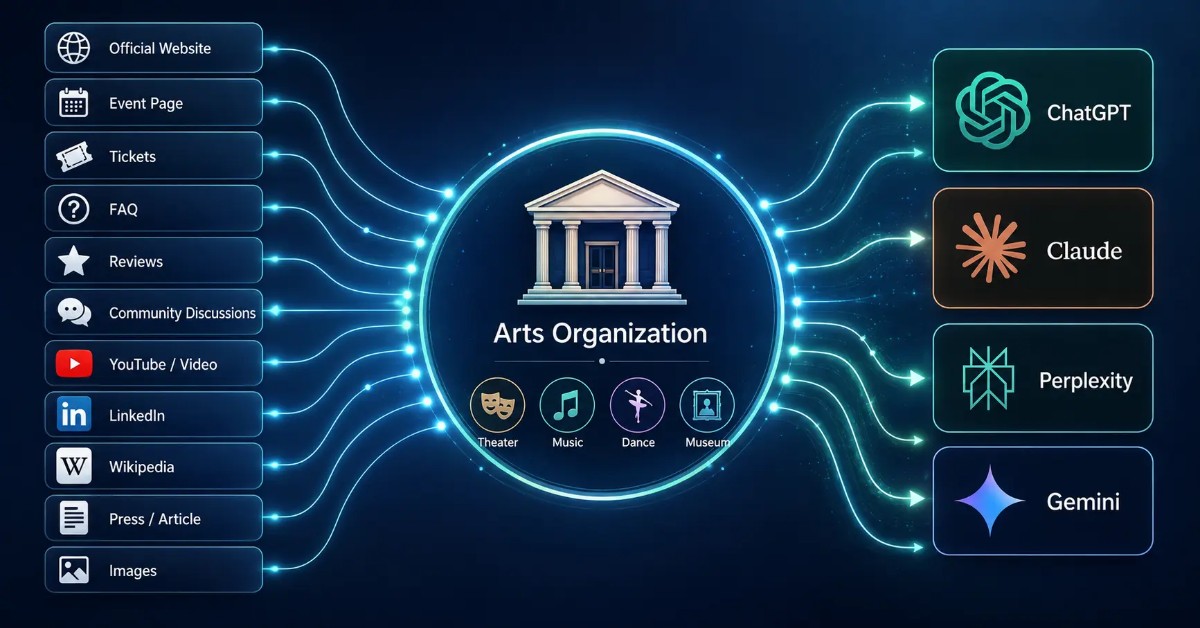
Announcement as the campaign. A season reveal, press release, list email, and on-sale posts publish information to people who already follow the organization. As covered in why event listings alone don't create audience growth, a published event can stay invisible to anyone outside that circle.
Insider framing. Premiere status, provenance, conductor credits, and anniversaries reassure existing audiences but tell little to someone deciding how to spend a Friday night.
Marketing as a department rather than an organizational function. Pricing, programming, front of house, the event page, and the ticket journey all shape results, and they usually sit outside marketing. That shift is the subject of rethinking the nonprofit marketing mindset.
Spending more on its own doesn't fix any of these. What usually helps is changing what the campaign is for.
Job one: reaching people outside the database
The useful distinction here is between demand capture and demand creation. Search ads and retargeting capture existing intent, so they are capped by how many people are already looking. Discovery creates an entry point for someone browsing for something to do who hadn't considered your art form. Both have a role, but only discovery grows the pool. The mechanics are set out in event discovery vs. event promotion.
In practice, this means being present and legible wherever people in your market look for cultural plans, not only where your art form's existing audience gathers, with listings written for someone who doesn't recognize the title.
Job two: being understood in one screen
A prospective attender is weighing four questions: What is this? What will it feel like? Why might I like it? What happens when I arrive? Credits, premiere history, and awards still belong on the page, but further down, where they support the decision rather than lead it.
Two quick checks:
Ask someone outside the sector to describe what happens in the event from your description alone.
Check whether the page answers the questions people rarely ask out loud: what to wear, how long it runs, whether they'll follow it, and whether they'll feel out of place.
This matters more than it looks. In LaPlaca Cohen's Culture Track '17 study, the top barrier to cultural participation was feeling that an activity is "not for someone like me," followed by "I didn't think of it." Both ranked above inconvenience, having no one to go with, and cost. The first is a job-two problem; the second is a job-one problem.
Job three: being chosen on the night
For a newcomer, the alternatives are rarely other arts organizations. They are dinner, a film, or staying home. That changes the comparison from "this production or that one" to "why go out at all."
It also suggests the product is often the evening as well as the performance: the building, the neighborhood, the hour beforehand, who to bring, what to do after. Much of this already exists and rarely appears in campaign creative. Partners matter here because a recommendation from a business people already trust carries weight an organization's own advertising can't. What to ask for and what to offer is covered in the partnership playbook.
Job four: what turns a first visit into a second?
A good first visit doesn't automatically lead to a second purchase, and better tooling alone doesn't close the gap. Georgia Rivers, then Opera Australia's marketing director, reported in 2020 that 60% of the company's customers had been only once, despite its CRM efforts. The sector figures from TRG Arts and Spektrix suggest that this is the norm rather than an exception.
Approaches that treat the second visit as its own campaign include:
One specific next recommendation, sent within weeks. A first-timer has no framework for choosing from a full season.
Entry offers that carry past the first ticket, so a newcomer isn't immediately asked to pay a higher price on the second visit.
A reusable asset from every campaign, such as contact details and consent, so a sale can become an ongoing relationship.
Organizational recognition alongside the event, so someone who enjoyed the show knows whose show it was.
The longer-term case is set out in cultivating new audiences, not just selling more tickets: the two goals can look identical for one season and diverge sharply over five.
How is marketing different from audience development?
Marketing promotes programs to generate awareness and action. Audience development is the longer-term work of deciding whom to reach, understanding their barriers, shaping the experience, and building relationships that produce return visits. Marketing is one instrument within it, alongside programming, pricing, access, education, and community relationships.
The distinction helps with diagnosis. "This show isn't selling" is a marketing question. "Our audience is the same people it was a decade ago" is an audience-development question, covered in audience development strategies for arts organizations.
How does execution differ by organization type?
The four jobs hold across disciplines, but sales windows, season structures, and what audiences already know vary:
Theaters: title recognition varies show to show, and the season is the unit of loyalty. See the theater marketing guide.
Opera companies: a high perceived barrier to entry, and subscribers whose motivations differ from newcomers'. For reaching people under 40, see how opera companies can attract younger audiences.
Orchestras and classical presenters: repertoire is often unfamiliar by name but familiar by sound, which changes the framing job.
Museums and galleries: low-commitment visits, long exhibition windows, and the advantage of being a place to spend time.
Festivals: compressed, lineup-driven sales windows that depend heavily on discovery by people planning a weekend.
Which metrics show whether marketing is compounding?
Total tickets sold can hide the fact that every buyer came from the existing list. These measures separate growth from repeat purchasing:
New-buyer share: the proportion of buyers who had never bought before
Discovery source: where new buyers first found you, rather than last-click attribution
Cost per new buyer, tracked separately from cost per ticket
First-time buyer retention: the share who return within twelve months
Time to second purchase: an early indicator of audience health
Instrumentation is covered in what audience data arts organizations should track.
Where does paid media fit?
Paid media extends what already converts. It doesn't make an unclear event page clear, and traffic sent to a page that doesn't convert can make it look as though marketing doesn't work. A practical order is to fix the page, confirm the message reads clearly to an outsider, then scale spend. For budget-constrained tradeoffs, see how to market cultural events with a limited budget.
How CultureOwl fits in
Owned channels reach people you already have, and Culture Track found "I didn't think of it" is the second-biggest barrier to attending. That makes being found the hardest job to solve in-house. CultureOwl is event discovery with low-cost ticketing, built for the arts, used across multiple markets by people browsing for something to do before they've picked an organization. Visibility there builds up around the organization as well as the individual event, so the next season doesn't start from zero, and the next campaign is easier to run.
Frequently Asked Questions
What are the four jobs of arts marketing?
Be found by people who aren't looking for you, be understood in one screen, be chosen over other plans for the evening, and be repeated so first-time attenders return. The fourth is the one that compounds directly.
What is the difference between arts marketing and audience development?
Marketing promotes specific programs to drive near-term awareness and action. Audience development is the longer-term work of choosing whom to reach, removing their barriers, and building reasons to return, and marketing is one tool within it.
Why don't first-time attenders come back?
Most don't, across the sector. TRG Arts' benchmark finds only about 25% of first-time buyers ever buy a second ticket, and Spektrix found 19.5% of UK first-time bookers in 2022 returned in 2023. Opera Australia reported 60% of its customers had been only once despite CRM efforts. That is why the second visit is best treated as its own campaign.
How do you measure whether arts marketing is working?
Track new-buyer share, discovery source, cost per new buyer, first-time buyer retention, and time to second purchase. Total tickets sold can look strong even when nothing durable is being built.
Key takeaway
Arts marketing works best as four ongoing jobs (be found, be understood, be chosen, be repeated) rather than a series of event launches. With roughly three in four first-time buyers never returning, the second visit is where most value is lost. The test before any campaign ships: when this run closes, what will still be here?