
The hardest part of audience development has already happened at a lot of opera companies, and it happened without much help from marketing. OPERA America's national study of post-pandemic audiences — more than 11,000 operagoers across 36 U.S. companies, produced with the cultural research firm Slover Linett at NORC — documented record levels of first-time attendance in the seasons following the pandemic. People who had never been to an opera bought a ticket and came. What the sector is still working out is what happened next.
That reframes the problem. Attracting younger audiences to opera is usually discussed as a persuasion problem: how do we convince people who think opera isn't for them that it is. The research points somewhere else. Among New-to-Opera respondents, 59% said they attended because they wanted to discover a new experience, compared with 26% of those new to a particular company and 12% of ongoing audiences. Curiosity is not the scarce resource.
Opera doesn't need to be made easier for younger audiences. It needs to be easier to enter. Those are different projects, and conflating them is why so much of this work stalls. Making the art easier means shortening, translating, simplifying, apologizing. Making entry easier means removing the friction that sits around the performance: knowing the event exists, understanding why it might be for you, knowing what to expect when you arrive, and being given a reason to come back before the memory fades.
Which means the real answer to how to attract younger audiences to opera is less a campaign than a sequence, and that is how this is organized, because it is how the evidence behaves: curiosity → discovery → first visit → connection → return. Most companies are strong at one or two stages and have nothing built at the others. The gaps are where the audience leaks out.
Is Gen Z interested in opera?
Yes — and the more useful version of that finding is that interest is behavioral, not generational. OPERA America's research segments audiences by relationship to the art form (New-to-Opera, new-to-company, ongoing) rather than by birth year, and found that newcomers to opera companies are more diverse than ongoing audiences both in age and in racial and ethnic identity. The parallel data in classical music is stronger still: a 2022 Royal Philharmonic Orchestra study found 65% of people under 35 regularly listen to orchestral music, and the LA Philharmonic reported that Gen Z, Millennial and Gen X audiences made up 63% of its 2024/25 attendance.
The practical implication is to stop building campaigns around a generation and start building them around a behavior. A 34-year-old attending her first opera and a 61-year-old attending his first opera need almost identical things from you, and both need something quite different from the subscriber in row F. If your audience personas are cut by age bracket rather than by prior experience with the art form, they are pointing your marketing at the wrong distinction.
Why are younger audiences interested in opera?
Because opera delivers what experience-driven audiences are already seeking elsewhere: emotional intensity at a scale everyday life rarely offers, live human skill that can't be faked, and spectacle built from music, theatre and design at once. ArtsHub put it well in describing opera as "the original multi-sensory experience: music, theatre, spectacle, emotion, all woven together," with "the intensity and emotional literacy young people value."
This matters for messaging more than for programming. Love, grief, jealousy, ambition and betrayal are not context an audience needs explained before they can enjoy an opera — they are the product. A significant amount of opera marketing leads instead with institutional credentials: the composer, the production's provenance, the conductor's résumé, the company's anniversary. Those signals reassure people who already attend and communicate almost nothing to someone deciding how to spend a Friday. Lead with the emotional promise; the credentials can follow.
Kasper Holten, chief executive of the Royal Danish Theatre, made a related argument on the Artelize Podcast that is worth holding onto: in an era of algorithms that reliably serve people more of what they already know, the arts are one of the few things that expose someone to what they didn't know to ask for. He frames it as a fight for curiosity. The marketing consequence is that curiosity is a more useful entry requirement than expertise — and a campaign that assumes familiarity is quietly disqualifying the exact audience it is trying to reach.
What keeps younger audiences from attending opera?
Mostly uncertainty, not disinterest — and the uncertainty is social before it is financial. OPERA America's research documented newcomers' unease about what to wear, whether they would follow the translations, and whether they would feel like they belonged in the room. ArtsHub reports the same pattern: unfamiliarity makes attending "feel like a big step."
The finding on cost deserves precision, because it is routinely misquoted. In the OPERA America data, ticket price is not primarily what stops a first visit — it is what prevents audiences from returning more often, and it bites hardest on newcomers. That is a meaningful distinction for anyone building a pricing strategy. Discounting the entry ticket addresses a barrier that is real but secondary; the barrier that costs you the relationship shows up at ticket number two. If your under-40 pricing exists only on the first purchase, it is solving the wrong half of the problem.
Accessibility, in this context, is broader than price. It includes knowing the event exists at all, understanding why it might appeal to you, knowing what the evening will be like, an understandable ticket journey, and seeing people recognisably like yourself in the room. Any one of those failing is enough to keep a curious person home.
Stage one: get discovered outside your own database
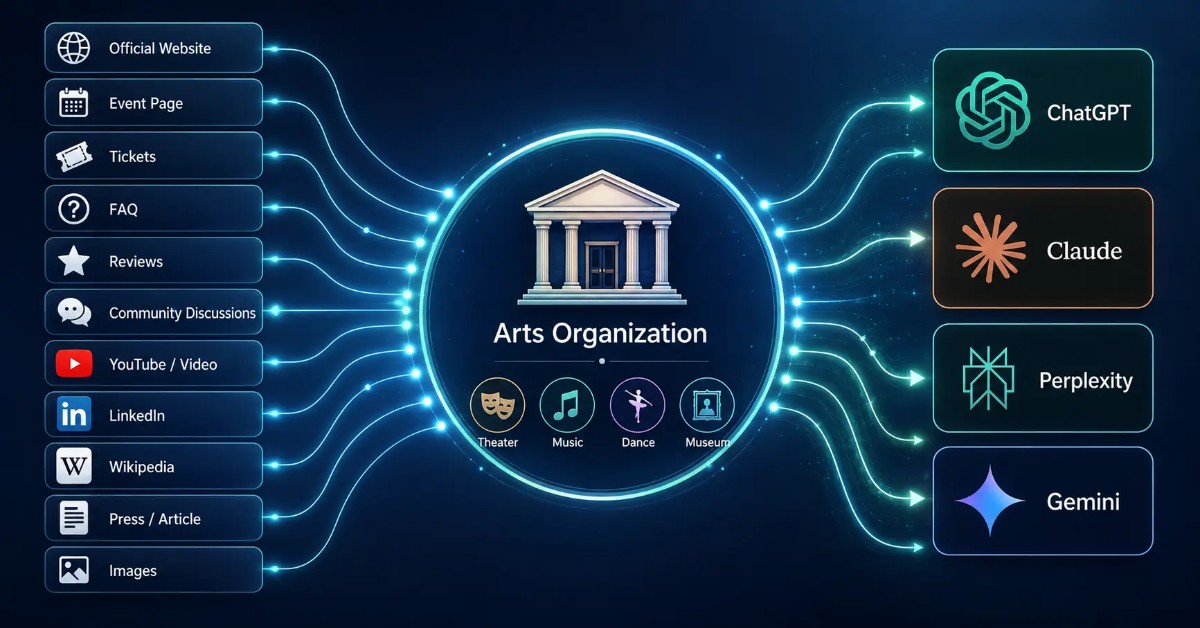
An organization's owned channels reach people who have already raised their hand. Email lists, social followers and the season brochure are retention tools wearing acquisition clothing — they are excellent at reactivating a lapsed attender and structurally incapable of reaching someone who has never heard of you. If first-time attendance is the goal, most of the work has to happen on channels you don't own.
This is the stage most often skipped, because it looks like it's already handled. It usually isn't. Publishing an event page and syndicating a listing are not the same activity as being discovered, and we've written before about why event listings alone don't create audience growth and the practical difference between event discovery and event promotion. Promotion pushes a message at an audience you've already defined. Discovery puts your event in front of someone who was looking for something to do and had not thought of opera — which, given that 59% figure, is a larger group than most companies' targeting assumes.
Practically: make sure the event is present and legible wherever people in your city browse for cultural plans, not only where opera audiences already congregate. Write the listing for someone who does not know the title. And treat local cultural discovery platforms, city guides and editorial coverage as acquisition infrastructure rather than as a box to tick after the campaign is built.
Stage two: lower the perceived risk of a first visit
A first-time attender is making a bet with money, an evening and a small amount of social risk. Everything that reduces the sense of risk raises conversion, and recognition is the most powerful lever available.
Do younger audiences prefer new operas or classics?
Neither — they prefer titles they've heard of, and this is the single most important correction in the recent research. OPERA America's original report was widely read as evidence that newcomers stick to the classics. In December 2025 the organization published a formal correction: the driver is name recognition, not the age of the work.
The revised analysis is worth understanding in detail. 82% of newcomers expressed interest in "famous or well-known" opera, while individual new-work characteristics scored between 17% and 41% — the numbers that produced the original interpretation. But when the four new-work categories were combined, 61% of newcomers expressed interest in at least one, substantially narrowing the gap. OPERA America also noted that the 82% figure itself encompasses recognizable contemporary titles, not only inherited repertoire, meaning the real gap is smaller still. And a third correction addressed availability bias: 81% of first operas attended were "famous or well-known," but companies' seasons in 2022–23 were 73% pre-1970 work. Newcomers largely attended what was on offer.
This is a much better brief for a marketing department than "programme the hits." Familiarity is an entry point that does not dictate the age of the repertoire. A new work with a recognizable source — a known novel, film, historical figure or story — can carry the same low-risk signal as a warhorse. Which means the practical question for a season is not old or new but: what makes this title recognizable enough that a first-timer will take the bet? If the answer is nothing, that is a marketing problem to solve with framing, context and cultural reference points, not a reason to avoid the work.
Stage three: let people be the entry point
Institutions are hard to enter; individuals are easy to follow. Younger audiences overwhelmingly arrive at established art forms through adjacent interests and trusted people rather than through institutional advertising — which makes performers, staff and outside creators an acquisition channel, not a content-production afterthought.
Can social media attract new opera audiences?
Yes, when it is used to lend an unfamiliar institution a human face rather than to broadcast programming announcements. The clearest documented example in the adjacent orchestral world is the St. Louis Symphony Orchestra, which Forbes reports has hosted more than 83 social media creators at Powell Hall, generating over 10 million social views. One creator alone — TikTok personality Tani Lior, who reacts to classical music through a hip-hop lens and attended her first orchestral concert at the SLSO — produced content that drew over 11 million views. More than half of the SLSO's audience is now Gen X, Millennial or Gen Z.
"Gen Z engages with culture differently than older generations," SLSO president and CEO Marie-Hélène Bernard told Forbes. "We're intentional about meeting people where they are — removing barriers and creating genuine experiences."
In opera specifically, CULTURED has documented the Metropolitan Opera leaning on creator partnerships built around "get ready with me" and backstage formats — content that frames the evening as an occasion to go out rather than as an education in the art form. That distinction is the whole game. A creator explaining opera produces a lesson; a creator getting dressed for the opera produces an invitation.
Two things make this work in practice. First, the creator has to be given real access — backstage, rehearsal, the dressing room — because access is the only thing they can't get anywhere else, and it is what their audience actually watches. Second, do not restrict the collaboration to a giveaway or a ticket trade; a joint post, a takeover, or simply an honest reaction from someone whose taste their followers trust will usually outperform a transactional promotion. The same logic governs partnerships with local businesses and venues, which we've covered in more depth in the theater partnership playbook.
One more point on digital, because it is often treated as competition for live attendance: OPERA America found that many New-to-Opera attenders listen to and watch opera recordings before attending in person. Clips, streams and recordings are pre-visit conversion content. They are how a curious person checks whether they'll like it before spending on a ticket, and companies that treat their digital catalogue as a rival to the box office are suppressing their own acquisition funnel.
Stage four: market the whole night, not only the performance
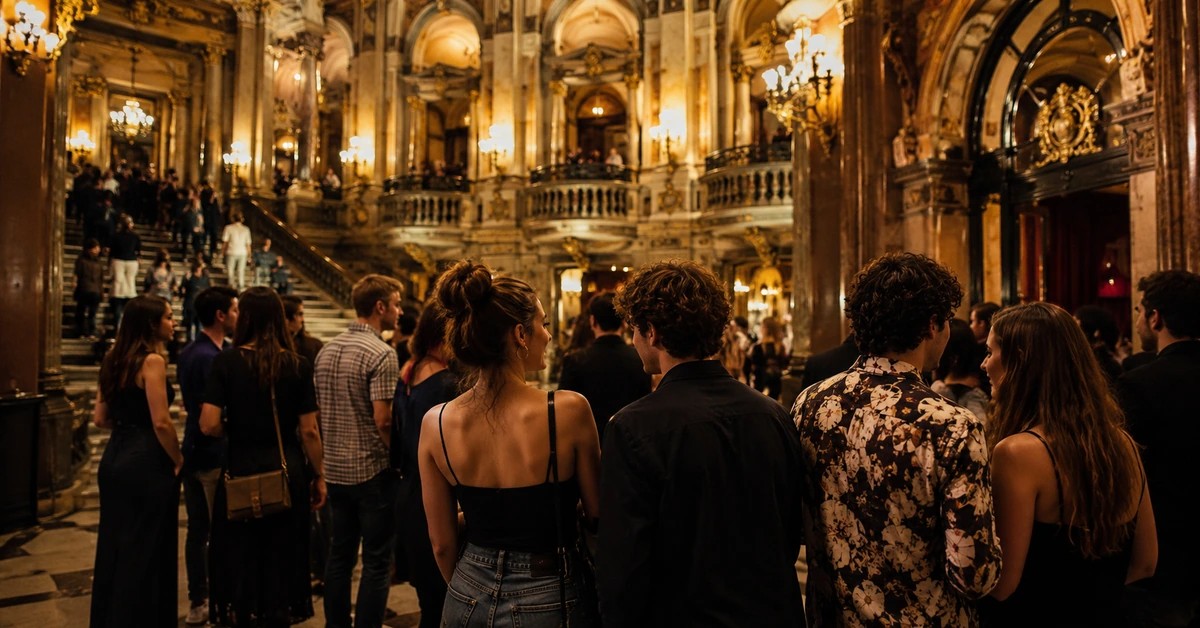
Museums let visitors linger, browse and socialise at low commitment. Opera houses have historically concentrated nearly all of their value into two and a half hours in a dark room, with a lobby that exists to be walked through. OperaWire's 2026 argument that opera houses should function as social "third places" is directed exactly at this, using Opéra de Lille as its example — a building in the historic city centre whose grand staircase works as a gathering point, running late-night chamber programming and alternative formats alongside the main season.
The Metropolitan Opera's Met Under 40 programme is the same insight applied commercially: discounted tickets for attenders 40 and under, wrapped around a monthly 90-minute pre-show party on the grand tier with cocktails and a step-and-repeat. CULTURED reports the average Met Under 40 attendee is 31, against an average single-ticket buyer age of 44 across the house — itself down from 50 before the pandemic.
Read those two examples together and the tactic is clear: the lobby, the drinks, the architecture, the neighbourhood, the pre-show hour and the conversation afterwards are all part of what you are selling, and most of them are already paid for. This is one of the cheapest interventions available to a company with a real building, and it should be weighed against the more expensive options in any assessment of how to market cultural events on a limited budget. It is also, importantly, one tactic inside a system — a beautiful lobby will not rescue a company with no discovery strategy and no plan for the second visit.
Stage five: engineer the second visit
This is where the sector's real leak is. OPERA America found that New-to-Opera attenders have positive experiences and are eager to recommend opera to others — the first visit largely works. But willingness to recommend is not the same as returning, and returning is where the economics live — which makes opera audience retention, not acquisition, the stage most worth staffing. As we've argued before, the goal is cultivating new audiences, not just selling more tickets.
How can opera companies turn first-time attendees into repeat audiences?
By treating the second purchase as its own campaign with its own budget, rather than as something the first visit will produce on its own. The Met's Fridays Under 40 programme is the most useful published benchmark here: OPERA America reported that 56% of its attenders were new to the Met and 25% went on to purchase full-price tickets, at a price point of $100 for a party-plus-orchestra-seat package or $80 for an off-night orchestra seat. A quarter converting to full price is a genuinely strong result — and it is also a reminder that three-quarters did not.
What the research suggests about closing that gap:
Extend the entry price past the first ticket. Cost suppresses frequency more than it suppresses trial. A discount that expires after one visit converts a newcomer into a lapsed newcomer.
Recommend a specific next thing, quickly. A first-timer has no framework for choosing their second opera and will default to not choosing. "You liked this — come to this" outperforms a season brochure, and the window is weeks, not months.
Widen the eligibility window rather than narrowing it. Minnesota Opera's Tempo programme reached 400 households after raising its age cap from 39 to 45 — a reminder that "younger audience" schemes are often gatekeeping themselves out of their most convertible prospects.
Remove the practical blockers to a return, not just the emotional ones. Opera Theatre of Saint Louis charges $20 per child for supervised care during select matinees. Childcare is not an audience-development programme on paper, and it is one in practice.
Measure the second purchase as a headline metric. Most companies can state first-time attendance and cannot state what share of first-timers returned within twelve months. That single number is a better read on audience health than total tickets sold.
Does opera need to change to attract younger audiences?
The art form doesn't. The path to it does. There is no evidence in the current research that newcomers want opera shortened, simplified or translated as a precondition of attending — the Met's experiments with abridged, English-language productions are one legitimate entry format among several, not a template every company should adopt. Duration is a narrow reading of accessibility, and treating it as the main lever tends to produce a diminished version of the art that satisfies nobody.
What has to change is everything surrounding the performance: how the event is discovered, how the invitation is framed, how much risk a first purchase carries, how the building is used, and whether anyone has designed the second visit. That work is unglamorous and it is where the returns are. It also asks a real question of internal culture — much of it requires the kind of shift away from institution-first messaging we've described in rethinking the nonprofit marketing mindset.
Where AI is actually useful here
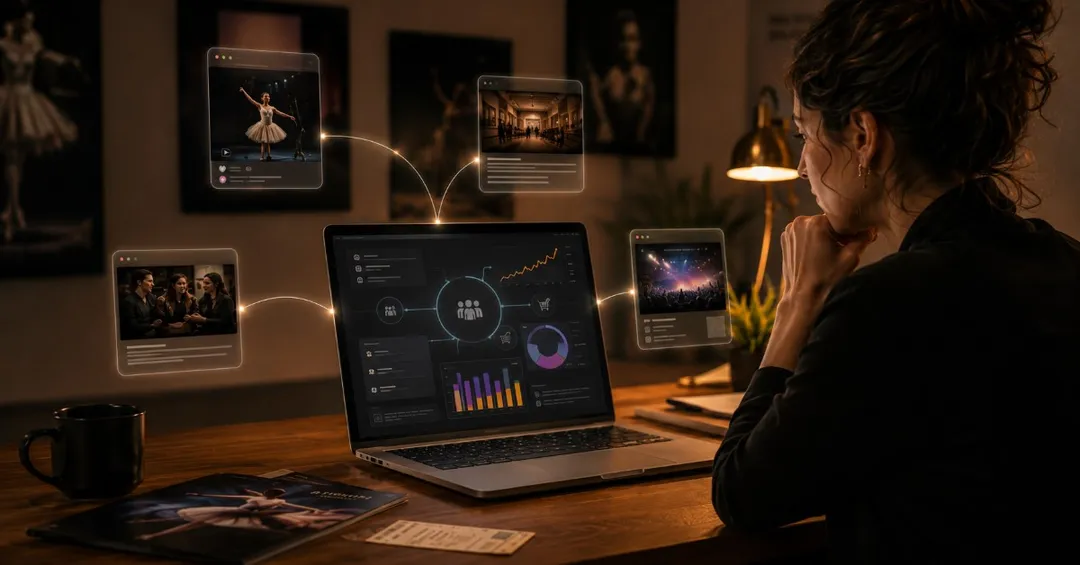
Not in deciding what to programme. The credible near-term use is finding patterns in audience data that a small team doesn't have the hours to surface — the same argument Holten makes when he talks about using AI to handle administrative complexity and reveal patterns staff would otherwise miss.
The questions worth pointing it at are operational: which content brings in first-time buyers rather than reactivating existing ones; which acquisition channels produce repeat attenders rather than one-off attendance; which titles genuinely attract new audiences versus reshuffling the existing base; how long the second purchase takes; and which segments cross between different kinds of cultural experience. None of that requires a new platform — it requires knowing what audience data your organization should be tracking in the first place, and most of the useful answers are sitting unread in a CRM.
Where to start if you can only fix one stage
Sequence the work rather than running it all as one campaign, and be honest about which stage is actually broken:
Discovery. Be present where people browse for something to do, not only where opera audiences already are. Write listings for someone who doesn't know the title.
Conversion. Reduce perceived risk. Lead with the emotional promise, answer the practical questions nobody asks out loud (what to wear, how the translations work, how long it runs), and give the title a recognizable hook — regardless of when it was written.
Experience. Sell the whole evening. Use the building, the hour before, and the room afterwards.
Retention. Fund the second visit as a campaign. Recommend a specific next event within weeks. Extend the entry price beyond ticket one, and measure return rate as a headline number.
The through-line is that curiosity about opera is already there and is not the constraint. The constraint is the number of steps between a curious person and a seat, and how few of those steps most companies have deliberately designed. Our broader guides to audience development strategies for arts organizations and performing arts marketing go deeper on the mechanics that apply across disciplines.
Sources: OPERA America, Understanding Opera's New Audiences and its December 2025 correction; OPERA America, "Accent on Youth" (Winter 2019); Forbes on Gen Z and classical music; CULTURED on younger audiences at major arts institutions; ArtsHub; OperaWire; and Kasper Holten in conversation on the Artelize Podcast.