A theater social media partnership is any collaboration, with cast and crew, local creators, sponsors, schools, or restaurants, in which both sides promote a production to an audience neither reaches alone. The evidence for doing it is stronger than most partnership advice admits: the NEA found socializing is the leading reason people attend performances, Americans for the Arts puts audience spending beyond the ticket at $38.46 per person per event, and the FTC now holds the advertiser, not just the creator, responsible for disclosure. This playbook covers what each partnership type actually buys, and how to tell which ones sold seats.
A theater's own following has a ceiling: everyone in it already knows the theater exists. The next audience sits inside someone else's following, a creator's, a restaurant's, a sponsor's, a cast member's personal circle, where the theater arrives as a recommendation rather than an ad.
The National Endowment for the Arts' When Going Gets Tough (2015), based on the 2012 General Social Survey, explains why that matters for theater specifically. 76% of performance attendees named socializing with friends or family among their reasons for attending, and over half were accompanied by friends at the most recent event. Among adults who were interested in an event but did not go, 22% cited not having anyone to go with as a barrier. A partnership that frames the show as a night out with someone, a date-night seat pair, a dinner package, a group outing through a school or employer, is working directly on the motivation and the barrier the NEA measured.
Cast and crew takeovers
The cheapest partnership is with people already in the building. Performers and crew have followings the official account cannot reach and access it cannot fake: the dressing room, the quick change, the ten minutes before places. A day-in-the-life post works because it reads as one person's real day, not as marketing.
The trade-off is control. Scripted takeovers lose the quality that makes them work, and loose ones risk spoilers. The practical middle is a few minutes of notice, one stated thing not to reveal, and the tag to use. Note that under the FTC's rules (below), a company member posting about their own show has an employment connection that should be disclosed if it is not already obvious from the post.
Creator collaborations, and the disclosure rule
The usual local exchange is a seat pair to opening night or a preview in return for a dedicated post or reel. In practice, smaller local creators are often reached with an invitation rather than a fee, and paid rates become more common as reach grows, though there is no reliable public benchmark for theater specifically.
The selection criterion that matters most is audience overlap, and the useful creator usually has little with the theater. Someone who covers food, date nights, or weekend plans reaches people who would never see a season announcement but are actively looking for something to do on Friday. Ask for a specific reaction, a moment, a reason to go before closing, rather than general enthusiasm.
The part many theaters miss is legal. The FTC's Endorsement Guides, updated in June 2023, treat free products and perks as a material connection: FTC staff guidance tells influencers to disclose "if a brand gives you free or discounted products or other perks," so comp tickets count. The Guides also say the advertiser "may be liable for a deceptive endorsement even when the endorser is not liable," and that advertisers should give endorsers guidance, monitor compliance, and act on lapses. FTC staff guidance also notes that vague tags such as "#sp" or a bare "thank you" are unlikely to be enough. A short disclosure line belongs in every creator brief.
Sponsorships with a defined exchange
A sponsorship is a partnership in which money or in-kind support is exchanged for visibility. It should appear on the theater's channels, not only in the printed program: tagged posts, the digital program, and, where the sponsor will fund it, a paid boost behind a specific show.
Sponsorships that renew tend to be the ones with a written exchange: what the sponsor gets (tagged mentions, placement, association with a specific production) and what the theater gets (funding, matched promotion, a boost budget). A sponsor whose promotion is also a public post about the theater is an endorser too, so the same disclosure logic applies to the sponsor's own posts.
Schools: the best-evidenced partnership
Student matinees are usually justified as access programming. The research supports a stronger claim. In randomized experiments run by University of Arkansas researchers with TheatreSquared in Fayetteville, school groups in grades 7 through 12 were assigned by lottery to receive free tickets to Hamlet or A Christmas Carol. The first round involved 49 school groups and 670 students. Students who saw live theater showed greater knowledge of the plot and vocabulary, greater tolerance, and improved ability to read the emotions of others.
The follow-up study, The Play's the Thing, extended this to five experiments over two years and added a comparison group that watched a film version of the same story. The live-theater groups showed higher tolerance, social perspective taking, and command of plot and vocabulary; the film groups did not. The authors also report that theater field trips "may cultivate the desire among students to frequent the theater in the future."
For a school, those findings are the reason to book a bus; for the theater, the last finding is the audience-development case. A study guide tied to the curriculum, and a ten-minute talkback with cast members, make the booking easier to justify. Internships and apprenticeships with local programs are a related, rarely counted partnership: they cost mentorship time rather than cash. For the under-35 pipeline beyond schools, see how theaters can attract younger audiences.
Restaurants and local businesses
The restaurant pitch can be made with numbers. Americans for the Arts' Arts & Economic Prosperity 6, based on 224,677 audience surveys, found that attendees at nonprofit arts and culture events spend $38.46 per person per event beyond the cost of admission, on meals, parking, and similar items. Attendees from outside the county spend more than twice as much as locals ($60.57 versus $29.77). A theater approaching a nearby restaurant is offering access to that spending, not asking a favor.
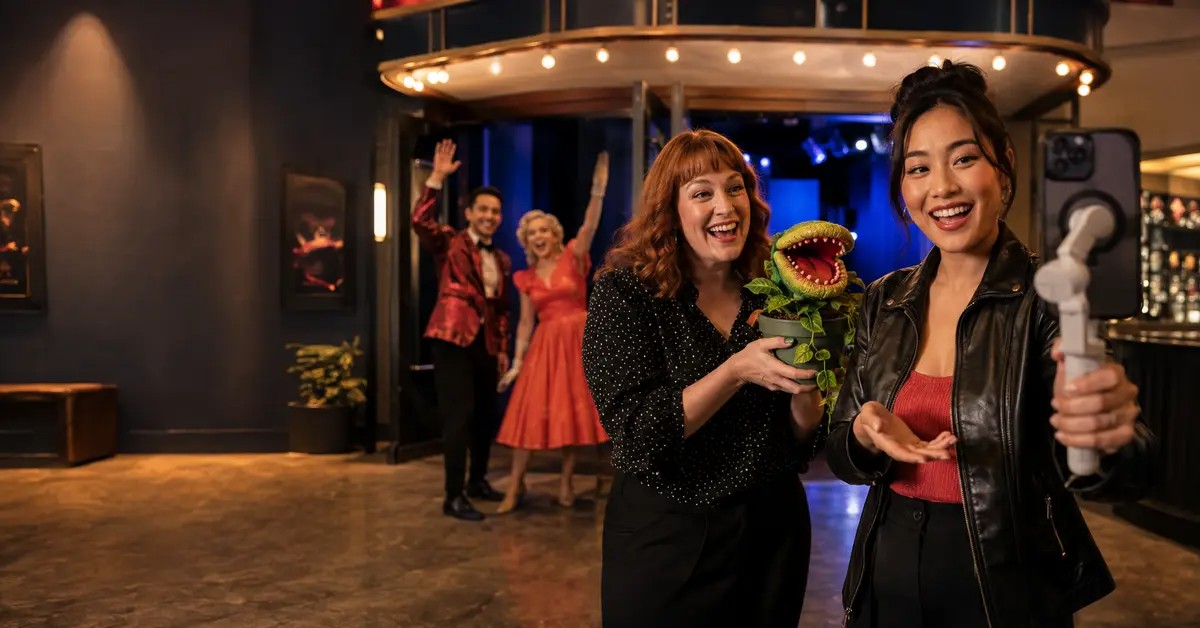
The format is simple: a dinner-and-a-show package, cross-posted by both sides, or one co-authored post (Instagram's Collab feature shows a single post on both accounts' profiles and distributes it to both sets of followers). Regional cultural hubs, arts newsletters, and local blogs work the same way.
When a giveaway is worth running
A package announcement asks for a purchase; a giveaway for the same package asks for an entry. Robert Cialdini's work on social proof, set out in Influence (1984), explains the difference: when people are uncertain, they look to what others are doing. Visible comments, tags, and shares are that signal, and an entry mechanic that requires a tag adds reach on top of it.
A deadline tied to the run, such as "closes before opening night," gives a reason to act now. A recognizable local partner makes the prize read as a community night out rather than a coupon. The trade-off: giveaways attract entrants who want a free night more than they want the show, so judge them on the follow-on ticket sales from the partner's link, not on entry counts. The winner's own posts are user-generated content worth planning for; see how arts organizations are using user-generated content.
Match the format to the platform
Rehearsal clips, quick changes, and takeovers are motion content for Reels and TikTok. Time-limited inventory belongs in Stories, which Instagram removes from profiles and feeds after 24 hours, so "eleven seats left tonight" does not linger on a permanent post after the show has closed. When money sits behind a partner's post, use Meta's location targeting, which can target cities, postal codes, or a radius around an address, so a boost for one venue is not spent on people outside driving distance.
The brief, before anyone posts
Every partner, creator, sponsor, or cast member posting solo, should get the same short brief before posting: what the show is about in two or three sentences, the one thing not to spoil, the tag or tracked link to use, and the disclosure line. Anything longer tends to go unread. The FTC's expectation that advertisers guide and monitor endorsers makes the brief a compliance step as well as a creative one.
Outreach that gets a yes
Vague asks ("we'd love to collaborate sometime") give a partner nothing to agree to. A workable pitch names the show, the date, the format on offer (a joint reel, a review, a Story takeover, a cross-tag, or a giveaway), and exactly what is wanted back. For example: "We'd love [restaurant] to be part of [show]'s opening week: no giveaway, just a post from each of us about the other."
The easiest first partners already have a reason to say yes: the restaurant the cast uses after rehearsal, the creator who already posts about the neighborhood, last season's sponsor.
Measure the click, not the tag
Engagement on a partner's post does not show whether anyone bought a ticket. Give every partner its own UTM-tagged link (utm_source= the partner, utm_campaign= the show). Without it, partner traffic arrives in the ticketing platform looking identical; with it, a season of partnerships becomes a ranked list of who to ask again. A partner that drove a handful of traceable sales is worth repeating; one that drove only likes is worth rethinking. For the wider measurement set, see what audience data arts organizations should track, and for the full visibility and ticketing system around this work, the theater marketing guide.
Think in seasons, not single shows
The partnerships that compound are the ones that outlive one run: the restaurant on every opening, the creator who becomes an informal ambassador, the sponsor people expect to see in the program. Two habits make that likely. Report back after closing with actual results (sales from the partner's link, clicks, audience response), and offer recognition that costs little, such as opening-night invitations, a mention in the curtain speech, or an early look at next season.
Do not ask a new partner for a season-long commitment before one exchange has worked. The common failure is not a bad idea but an undefined exchange and no follow-up. Two sentences in writing on what each side gives, gets, and by when prevent most of it. The same logic applies to the audience partners bring in: see how to earn the second visit.
How CultureOwl fits in
Partnerships work by putting a show in front of people who are looking for a night out but do not follow the theater, the social motivation the NEA identified. CultureOwl is event discovery with low-cost ticketing, built for the arts: people browse it across multiple markets for something to do, often before they know which theater they want. That gives partnership traffic and discovery traffic the same destination, and organizations can be followed directly so a first visit can become a relationship. More on audience growth.
Frequently asked questions
What is a theater social media partnership?
A collaboration with cast and crew, local creators, sponsors, schools, restaurants, or other businesses in which both sides promote a production to reach an audience neither could reach alone.
Do creators need to disclose free theater tickets?
Yes, under FTC guidance. The FTC's Endorsement Guides, updated in 2023, treat free products and perks as a material connection that should be clearly disclosed, and the advertiser can be liable too. Put a disclosure line in every creator brief.
Why should a restaurant partner with a theater?
Americans for the Arts' Arts & Economic Prosperity 6 found that nonprofit arts and culture attendees spend $38.46 per person per event beyond admission, including on meals. Nonlocal attendees spend more than twice as much as locals.
Is there evidence that student matinees build future audiences?
Randomized studies with TheatreSquared in Arkansas found that students who saw live theater gained tolerance, social perspective taking, and plot and vocabulary knowledge that a film version did not deliver. The authors report that the trips may also build a desire to attend theater in the future.
How should a theater measure a partnership?
Give each partner its own UTM-tagged ticket link and track ticket sales from it, not likes or tags.
Key takeaway
Theater partnerships rest on measurable ground: performance audiences come largely to socialize, arts audiences spend substantially beyond the ticket, and live-theater field trips show effects that film does not. Pick partners with little audience overlap, brief them with a disclosure line, give each a tracked link, and renew the ones that sold seats.