The most useful finding about AI and arts marketing isn't that search traffic is falling. It's which traffic is falling.
One Further studied 100 UK arts and culture organizations and found organic search traffic down about 10% between January and July 2025 — against a 30% rise across the same months a year earlier, and with 80% of them getting less from Google than the year before. But the loss wasn't spread evenly. Informational content — visitor guides, beginner explainers, collection pages — took the heaviest damage, while event and exhibition pages proved markedly more resilient.
That asymmetry is the whole strategic picture, and it follows from something obvious once said out loud. An AI system can answer "what is contemporary dance," "who was Gustav Mahler," or "what should I know before my first opera" completely, in place, without sending anyone anywhere. It cannot answer "what's playing Saturday" or "what can I do in Miami this weekend" without current information about real events — so it still has to point somewhere.
The same study found arts organizations appearing in an average of just 6% of relevant AI Overviews, the strongest reaching about 13%. Read that as opportunity, not indictment. Six percent isn't a competitive ceiling — it's an empty room.
What AEO actually means for an arts organization
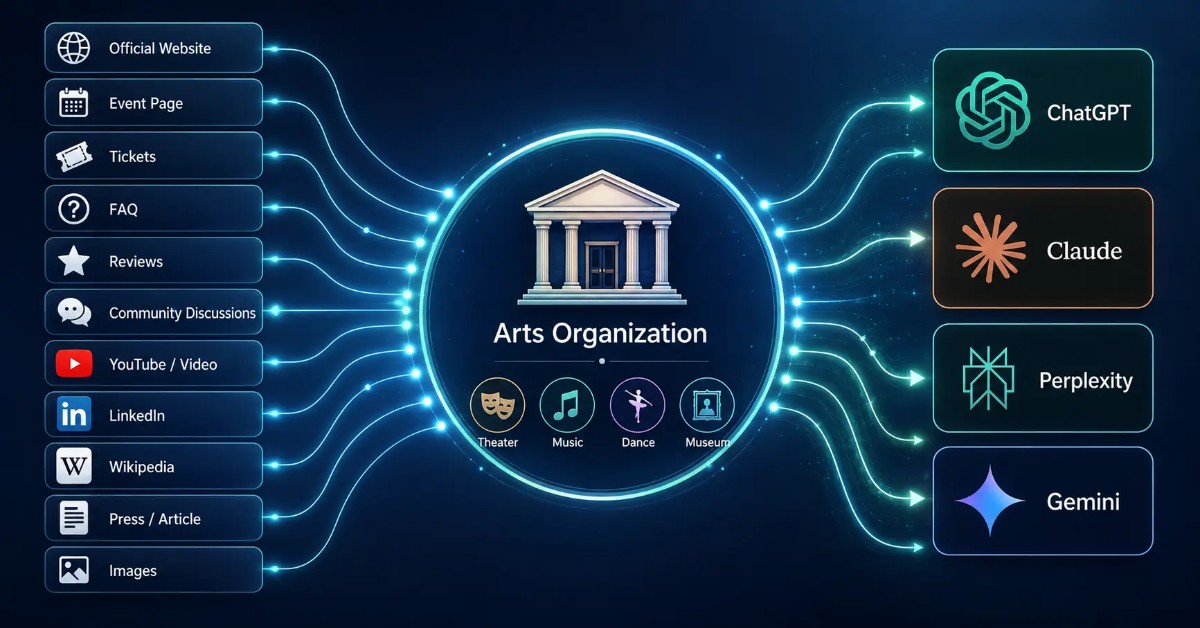
AEO — Answer Engine Optimization, sometimes called GEO, Generative Engine Optimization — is the work of making your organization legible and citable to systems that answer questions rather than list links: ChatGPT, Google's AI Overviews and AI Mode, Perplexity, Gemini.
The difference from traditional SEO is narrower than the vocabulary suggests, with one exception that matters. Traditional SEO earns a position in a list someone clicks. AI search earns your organization a role inside an answer — source, citation, recognized entity, recommendation — in a response the person may never click at all. Ranking first is no longer the same thing as being found.
What follows is not "abandon SEO." Google is explicit that its generative features are "rooted in our core Search ranking and quality systems," and that a page must be indexed and eligible to appear with a snippet before it can surface in an AI experience at all. The foundations didn't move. What changed is that your website is no longer the only place the answer gets assembled.
Our position, plainly: your website establishes the facts and the expertise. The wider web corroborates them. AI search increasingly connects the two.
Educational content may be losing clicks while gaining AI visibility
This is the finding most likely to change what an arts marketer does on Monday, and almost nobody in the sector is acting on it. Capacity Interactive analyzed the pages driving AI Search visibility across eight arts and culture organizations using Google Search Console data. Educational pages made up 58% of the sample but generated 73% of AI Search impressions — 1.23 million of them. Transactional pages were 31% of the sample and produced 11%.
Put that beside the traffic data and something counterintuitive emerges: the informational content losing traditional clicks is the same content earning AI visibility. Not contradictory findings — the same finding from two angles. An AI system reads your first-timer's guide, absorbs it, answers the question itself and doesn't send the click, while learning that your organization is a credible source on that subject.
So the distinction worth building a content strategy around isn't "SEO content" versus "AI content":
Educational content builds understanding and authority — first-time visitor guides, artist stories, composer background, exhibition explainers, program notes, interviews, what-to-expect pieces. Event content captures intent — individual event pages, performance and exhibition pages, calendars, ticket pages.
Which yields the instruction nobody wants while a traffic graph is falling: do not cut educational content because informational click-through is down. Those pages are doing a different job than your analytics dashboard was built to measure.
But don't let education become a dead end
Here's where most arts organizations leave value on the table. A page called First Time at the Opera? What to Expect — the same first-timer content that does the heavy lifting when you're attracting younger audiences — earns the visibility, answers the question, and stops. Nothing connects the person who now understands opera to the opera they could attend in three weeks. A guide to contemporary art in Miami should lead to current exhibitions, the museums showing them, and dated events.
If educational content creates AI visibility, internal linking converts it into attendance. Capacity Interactive's guidance agrees: strong internal linking, and event and ticketing pages that are actually indexable.
How AI systems use the wider web
AI answers frequently draw on information well beyond an organization's own website, and citation activity concentrates among a relatively small number of high-trust domains. A 2026 index compiled by 5W synthesized more than 680 million citations across ChatGPT, Claude, Gemini, Perplexity and Google AI Overviews, drawn from six studies conducted between August 2024 and April 2026, and found that activity heavily concentrated — with Reddit, YouTube, LinkedIn and Wikipedia among the most prominent sources.
Treat the percentages carefully. It synthesizes six studies with different methodologies, and estimates vary widely — Reddit's share alone ranges from roughly 12% to 40% depending which study you read, so anyone quoting a precise figure is overselling the precision. The direction isn't seriously disputed: community platforms and user-generated content now carry more weight in AI answers than most traditional media.
The consequence is concrete: you can write the most thorough page about your company that has ever existed and still be thinly represented in a system also reading Reddit threads, YouTube descriptions and Wikipedia entries to decide whether you're real and worth mentioning.
Public social content now has a search life beyond the feed
This is the part of AEO the arts sector is least prepared for, because it means treating social content as something other than feed performance. Be clear about what is and isn't true: nobody can promise a given Reel becomes an AI citation, and anyone who does is selling something. The defensible claim is narrower and still important — public social content creates additional machine-readable signals that help search and AI systems understand what an organization, artist, venue or event actually is.
The strongest direct case, because the pipeline is documented: OpenAI has a partnership with Reddit providing access to its Data API, and Google struck a similar agreement earlier the same year.
Consider what city subreddits are full of: what should I do this weekend, is this theater worth visiting, where can I hear live jazz — precisely the questions arts organizations want to be the answer to, asked where these systems demonstrably read.
What works is real staff participating as themselves — answering a question about accessible seating, explaining what a first-timer should expect, recommending another organization's show when it's the better fit. What fails, visibly and permanently, is a corporate account dropping listings. Participate because you know things worth sharing about culture in your city, or don't.
YouTube
Arts organizations are unusually well equipped here and don't realize it. You already produce rehearsal footage, artist interviews and performance excerpts. What's missing isn't content — it's the text around it. Titles, descriptions, captions and transcripts are how search systems understand what a video contains.
The difference is small and consequential. "Behind the scenes 👀 Don't miss it!" tells a machine nothing. "Inside rehearsals for Little Shop of Horrors at [Theater] in Atlanta, opening September 12" tells it the organization, the production, the city and the date. That isn't keyword stuffing — it's writing a title that says what the thing is.
Public LinkedIn content carries weight for institutional authority — a different asset than ticket sales. Artistic director insight, curatorial commentary, audience research, accessibility work, honest perspective on what's changing in the field: this is what establishes an organization as a knowledgeable entity rather than a venue with a calendar. Most arts organizations use LinkedIn only for announcements and hiring.
Since July 2025, public content from eligible professional Instagram accounts can be indexed by external search engines — an account-level setting worth confirming rather than assuming. It does not mean every Reel becomes an AI answer. It means public Instagram content now has a life outside Instagram, and captions carrying no facts waste it.
"It's almost here! 🩰✨" versus "[Organization] performs Swan Lake at [Venue] in Miami, October 12–15." The second isn't less charming. It's just not hiding every fact inside the image.
Consistent facts, varied storytelling
None of which means publishing the same paragraph everywhere. Consistency should apply to the facts. Variety should apply to the storytelling. Your website carries definitive event information. Instagram shows what the experience feels like. YouTube demonstrates the work. LinkedIn carries institutional expertise. Reddit is community conversation. Local media provides independent corroboration. A discovery platform provides market-wide context. Different registers, different jobs — but the event title, organization name, venue, city, dates and prices should be identical in all of them.
Why an AI system might not know your organization
The usual explanation — "training data is old" — is a third of the answer; modern AI search retrieves live web information too. Three causes matter:
Weak historical representation. A newer organization, a recently renamed one, or a smaller company with little press history may simply not be well represented in what these systems learned from. That's an absence to fill from outside your own domain, not a copywriting problem.
Current information that can't be retrieved. Pages must be crawlable and indexable. Google requires an indexable page eligible for a snippet before it can appear in generative features, and OpenAI tells publishers who want to appear in ChatGPT search to allow its OAI-SearchBot crawler. A ticketing subdomain blocked in robots.txt is self-inflicted invisibility.
Sources that disagree. When your address appears three ways across the web, your season dates differ between your site and the calendars carrying them, or your name is rendered inconsistently, a system has no reliable way to resolve the conflict — so it tends to omit you rather than risk being wrong. Reconciling your facts across third-party sources is unglamorous, free, and probably the highest-leverage hour you'll spend on this.
Event pages, freshness, and the shelf-life problem
Evergreen and event content decay on different clocks. An article about Beethoven stays useful for years; a concert on Saturday has a shelf life measured in days.
For events, currency is the whole game. Dates, times, prices, venue, ticket availability and cancellations need to be right now, not right last month. When an event ends, the page should stop looking like it's still upcoming — a stale listing doesn't just fail to help, it feeds wrong answers about you.
Every event page should state, in ordinary readable text, what the event is, who's presenting it, its art form, venue and city, date and time, price or price range, run time, age guidance where useful, the significant artists, accessibility information, and how to buy. Not inside a poster, not only in a booking widget. If the only place your event's date exists is inside an image, the event does not exist to a machine.
Same logic for images: Google uses surrounding text, filenames, captions and alt text to understand what an image shows. Descriptive filenames and real alt text take seconds.
Structured data helps. It doesn't guarantee anything.
Keep using relevant structured data — Organization and Event markup earn their place and help search systems parse your pages. But know the limit: Google states directly that "structured data isn't required for generative AI search, and there's no special schema.org markup you need to add." The same guidance says you don't need new machine-readable files for AI, including llms.txt, which Google Search ignores. Worth remembering next time someone sells you an AEO checklist. Most of the durable work here is ordinary work done properly.
What people are actually asking AI
The prompts that matter fall into four groups, each demanding something different.
Branded and factual. What's happening at [organization] this weekend? How long is [performance]? Is [museum] good for children? These need accurate, current, retrievable information on your own pages.
Local discovery. What cultural events are happening in Miami this weekend? What theater should I see in Atlanta? Where can I hear classical music in Tampa? These need your events represented somewhere with market-wide coverage — no single organization's website answers a question about a city.
Fit and recommendation. I've never been to the opera, what should I see first? What museums work for teenagers? These reward organizations whose educational content and event descriptions carry enough context to match an event to a person's situation — the thinking behind audience personas.
Constraint-based conversational search is the genuinely new one:
"I'm visiting Miami Saturday with two friends. We want something cultural but not a nightclub, under $60 each, somewhere we can have dinner nearby. What should we do?"
No keyword strategy answers that. Google describes query fan-out — a complex question decomposed into several concurrent related searches — and a prompt like that fans out into city, date, category, price and neighborhood. Every one of those constraints has to be findable somewhere for your event to survive the filtering. An event page that omits its price has already lost that query.
Don't build 100 pages for 100 prompts
A tempting and wrong response is to spin up separate pages for "opera first timer," "first opera," "opera for beginners" and "what to expect at the opera." One genuinely good page covers that whole cluster. Semantic coverage beats repetition, and thin near-duplicate pages make an organization look less authoritative, not more.
What earns citation is the opposite: original research, real expertise, a point of view — the standard we hold our own genre guides to, from the theater marketing guide to how to market an opera company. AI doesn't need another article telling it what it already knows.
How CultureOwl fits in
There's a category of question no arts organization can answer about itself, and it's exactly where AI recommendation queries land. An organization's website explains what that organization offers. Cultural discovery answers what there is to do.
A theater can represent its own season completely. It cannot represent the theater, dance, concerts, exhibitions, festivals and classes happening across its city — and shouldn't be expected to. Someone asking "what's playing at New World Symphony?" is well served by New World Symphony. Someone asking "what's something cultural to do in Miami on Saturday night under $50?" needs information spanning dozens of organizations at once. That second question is CultureOwl's territory.
Which is the distinction that matters: CultureOwl specializes in helping cultural events get found before the consumer necessarily knows which organization they're looking for. Not a listings dump — market-wide discovery, with events organized by city, category and interest, editorial context around them, and event information complete enough to survive a constraint-based query.
We won't claim that appearing on CultureOwl guarantees an AI citation — nobody can honestly promise that. What we will say: CultureOwl helps create the conditions AI-powered discovery increasingly depends on — events that are publicly accessible, accurately described, contextualized by city and interest, and represented beyond the presenting organization's own website. Same argument as event discovery vs. event promotion and why event listings alone don't create audience growth; the AI shift gave both a second reason to matter, and it's why we describe the goal as discovery that compounds. More via event promotion, audience growth and ticketing. We build it this way because we're a Public Benefit Corporation: the discovery layer under a city's culture should strengthen the organizations creating it, not tax them.
How to measure whether any of this is working
Not with rankings. Measure in layers:
AI visibility. Build a set of prompts you should plausibly appear in and test them repeatedly. Results vary by platform, phrasing and week, so a single test is an anecdote.
Google AI visibility. Search Console's generative AI performance reporting shows how pages perform in AI features.
ChatGPT referrals. OpenAI appends
utm_source=chatgpt.com, so it's separable in analytics.Branded demand. Whether more people start searching directly for your organization, event, production or artist — AI discovery creates awareness well before it creates a session.
Conversion. Tickets, registrations, signups, follows, visits. Fewer but better-informed arrivals can convert higher, and total sessions hide that entirely.
The honest hierarchy is AI visibility → recognition → discovery → visit → conversion, and most organizations measure only the last step. The fuller picture is in what audience data arts organizations should track.
If you only do five things
Make every event page complete, crawlable and current — in text, not graphics.
Create genuinely useful educational content around the questions audiences actually ask.
Connect it to relevant current events so learning leads somewhere.
Publish public social and video content with enough factual context to be understood outside the feed — none of which needs a production budget, as marketing on a limited budget lays out.
Build visibility beyond your own website through cultural media, community conversation and discovery platforms.
What not to do
Don't rebuild your marketing around AI — arts audiences still find events primarily through relationships, word of mouth, local media and email. Don't stop doing SEO; the generative features run on top of it. Don't write robotic content for machines, spam Reddit to manufacture mentions, hide event information inside graphics, assume structured data guarantees inclusion, abandon educational content because informational click-through is falling, or build repetitive pages for every imaginable prompt.
Frequently asked questions
What is AEO for arts organizations?
AEO — Answer Engine Optimization, sometimes called GEO, Generative Engine Optimization — is the work of making an arts organization legible and citable to systems that answer questions rather than list links: ChatGPT, Google's AI Overviews and AI Mode, Perplexity, and Gemini. Traditional SEO earns a position in a list someone clicks. AEO earns your organization a role inside an answer.
Is AEO different from SEO?
The foundations are the same. Google states that its generative features are rooted in its core Search ranking and quality systems, and that a page must be indexed and eligible to appear with a snippet before it can surface in an AI experience at all. What changed is that your website is no longer the only place the answer gets assembled.
How often do arts organizations appear in AI answers?
Research by One Further across 100 UK arts and culture organizations found them appearing in an average of just 6% of relevant AI Overviews, with the strongest reaching about 13%.
Should arts organizations stop publishing educational content if clicks are falling?
No. Capacity Interactive's analysis of eight arts and culture organizations found that educational pages made up 58% of the sample but generated 73% of AI Search impressions. The pages losing traditional clicks are the same pages earning AI visibility — they are doing a different job than a traffic dashboard was built to measure.
Do I need llms.txt or special schema for AI search?
No. Google states directly that structured data isn't required for generative AI search, that there is no special schema.org markup you need to add, and that Google Search ignores llms.txt. Keep using Organization and Event markup for the ordinary search benefits they earn.
What is the single highest-value AEO fix for a small arts organization?
Reconciling your facts — organization name, venue address, season dates, prices — so they match everywhere they appear online. When sources disagree, AI systems tend to omit an organization rather than risk being wrong. It costs nothing and takes about an hour.
The bottom line
The AI shift in arts marketing is real, measurable and asymmetric: it absorbs explanatory traffic while leaving event intent comparatively intact, and it rewards organizations consistent, corroborated and specific enough to cite.
With arts organizations appearing in roughly 6% of relevant AI Overviews, the task is unusually clear. Keep the educational content building your authority, and connect it to something someone can actually attend. Keep event pages complete and current. Make your facts identical everywhere. Give public social and video content enough context to be understood by a machine. And accept that a meaningful share of this now happens on sources you don't own.
Nearly all of that work pays off in ordinary search, and with actual humans, regardless of how the AI question resolves — which is what makes it worth starting now. For the wider system this sits inside, see how to market arts and cultural events.