Arts organizations are not short of first-time buyers. TRG Arts' sector benchmark puts first-timers at 66% of all ticket buyers, and only about 25% of them ever buy a second ticket. The research on why people don't attend points to awareness and relevance more than price, and the main route people use to find events, search, is sending fewer clicks to websites. Promotion and discovery address different parts of that problem. This piece sets out the evidence for where each one works and where each one runs out.
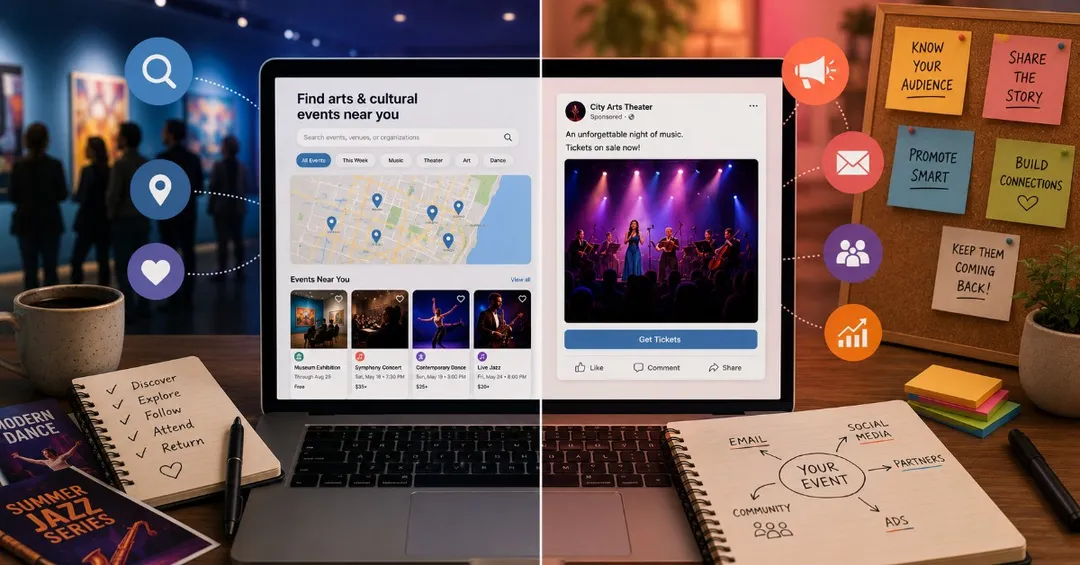
Promotion concentrates attention on one event for a defined period. Discovery is the standing presence that lets people who aren't looking for a particular organization find it, and then find it again. The two get budgeted as if they were interchangeable, but they are paid for differently and they produce different kinds of value. A campaign stops working when the spend stops. Discovery builds up across a season.
The problem is retention, not acquisition volume
TRG Arts' benchmark data shows the sector acquiring new buyers easily and failing to keep them: 66% of ticket buyers industry-wide are first-timers, but only about 25% ever come back for a second ticket. In other words, most event-level promotion is already succeeding at the thing it's built for, which is getting a first purchase for a specific show.
The longer trend makes this harder. TRG's analysis of 163 arts organizations across the US and Canada from 2018 to 2025 found household volume above pre-pandemic levels while average orders per household fell from roughly 1.5 a year to 1.45, and the share of single-ticket buyers attending only one event a year grew. Organizations are reaching more people, and each of those people does less.
If each campaign brings in a new group that mostly doesn't return, then the next campaign has to buy that attention again. So spending more on promotion doesn't fix it. The useful question is what's still there once the campaign ends. For the second-visit side of this, see arts audience retention: how to earn the second visit.
Most non-attendance is an awareness and relevance problem
LaPlaca Cohen's Culture Track '17, a national survey of 4,035 US adults, ranked barriers to cultural participation. The top barrier was feeling an activity is "not for someone like me," followed by "I didn't think of it." Both ranked above inconvenience, having no one to go with, and cost.
Indigo's Tomorrow's Audience research (72 UK performing arts organizations, 32,600 survey responses, with Spektrix) found much the same among first-time attenders. It grouped their barriers as "Not on my radar," "Too hard," and "Poor value," and found three motivators for a first visit, People, Familiarity, and Occasion, with people generally needing at least two in place before they attended.
This explains why promotion and discovery do different work. A campaign for one production can deal with "too hard" and "poor value" for that production. It reaches people when the campaign is live and stops when it ends. "I didn't think of it" and "not on my radar" are standing conditions. To change them, an organization has to be visible where people browse for something to do, regardless of whether anything is on sale that week.
Where people actually hear about events
The National Recreation and Park Association's 2024 Park Pulse poll asked US adults how they find out about local events in their community. Social media (66%) and word of mouth (59%) led, with Facebook the top platform at 53%. Local government websites came last. Word of mouth was the top source for Gen X (69%) and Boomers (63%), and more than half of Millennials and Gen Z relied on social media first.
Culture Track '17 found a similar pattern for cultural activities specifically. Editorial mentions in print still influenced participation the most, and social media had become the number one advertising source, ahead of newspaper and magazine ads.
These are general-population figures, not arts-buyer data. Still, the direction is consistent across both: people find events through other people and through places they already visit to browse. They rarely start on the website of an organization they haven't heard of. An organization that is visible only on its own channels is visible only to people who already know it.
Search is sending fewer people through
The channel that used to catch "things to do this weekend" intent is changing. Pew Research Center analyzed the browsing data of 900 US adults in March 2025. Users who saw a Google AI summary clicked a traditional search result in 8% of visits, against 15% for users who didn't see one. They clicked a link inside the summary in 1% of visits, and they were more likely to end their browsing session entirely (26% versus 16%).
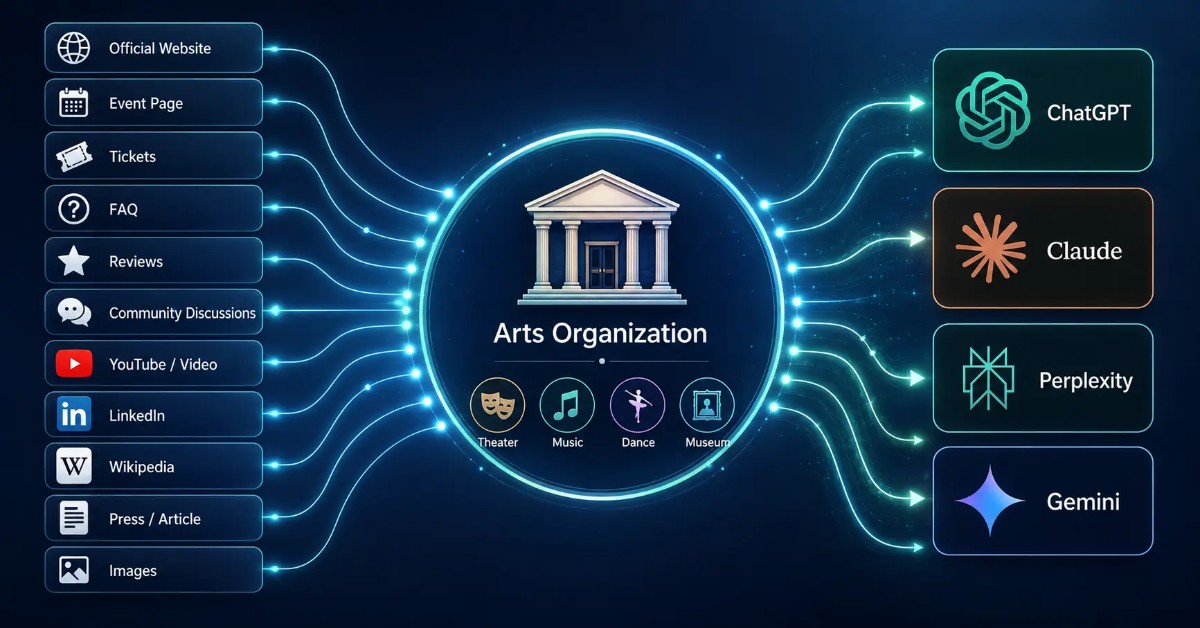
For a prospective attender asking what's on nearby, the answer is now often assembled from sources the person never visits. An event that exists only as a page on its presenter's website is easier to leave out of that answer. One that appears consistently on sources answer engines draw from, with structured details about date, venue, and what to expect, is easier to include. The mechanics are covered in AEO for arts organizations.
A listing is not the same as discovery
Publishing an event makes it available. That doesn't mean a relevant audience will come across it.
Many ticketing and calendar platforms work mainly as publishing tools. The organization builds the event page and then supplies nearly all the traffic through its own email, social, advertising, and website. That's a reasonable model for organizations with strong existing demand. It doesn't reach anyone who hasn't already thought of you.
A discovery environment has an audience that visits on purpose to see what's happening, and it lets people browse by date, category, location, and interest without knowing a title or presenter. It also links the event to the organization behind it, so the visit doesn't end when the event does. This is why event listings alone do not create audience growth.
What promotion does well, and where it stops
The Wallace Foundation's Building Audiences for Sustainability initiative awarded nearly $41 million to 25 performing arts organizations between 2015 and 2019, and the University of Texas at Austin independently studied the results. Three findings bear directly on how to divide budget between promotion and discovery:
What usually worked was communication: more welcoming, less jargon-heavy messaging, and more use of digital and multimedia channels, including video trailers for challenging work.
"Crossover strategies" were consistently disappointing. These were special programs designed to bring new audiences in, in the hope that they would move on to traditional programming. Many organizations came to question what one interviewee called the "long, slow escalator" from first visit to subscriber.
Audiences grew, but subscriptions fell and attendance frequency declined over the course of the initiative.
The lesson is not that promotion fails. When promotion explains a specific event clearly and reaches people in the channels they already use, it moves tickets. What it can't be counted on to do is turn an event-specific buyer into a relationship with the organization. That depends on whether the person can find the organization again, and whether they're given a reason to.
Promotion spending should go where it makes the biggest difference. A practical diagnostic:
Low traffic, good conversion: the event needs visibility, and promotion is the right tool.
Strong traffic, weak sales: the problem is positioning, price, page content, or checkout. More reach won't fix it.
Buyers who come once and never return: this is an audience-development problem. Another campaign won't solve it.
Unfamiliar work, short runs, new series, and ambitious attendance targets usually justify paid support. A familiar annual event often sells through discovery and owned channels alone. For creative and targeting that convert, see how to build ads that actually sell tickets.
Why promotion without discovery gets expensive
Every campaign ends. Without a standing discovery presence, the next event starts from close to zero. The organization buys attention, gets a round of sales, and does the same thing for the next program.
Ads that perform well can still make the overall program feel more expensive every year. The cost per campaign may be fine. The trouble is that little value carries over from one campaign to the next. A buyer can purchase without learning what else the organization does. Someone who is interested but busy that night has no obvious way to hear about the next program. With a 25% return rate, every one of those losses has to be replaced with new acquisition spend.
Discovery gives promotional spending somewhere to land. An ad, an email, or a partner mention can then introduce the organization as well as the event. For organizations with tight resources, marketing cultural events with a limited budget depends on each campaign contributing to the next.
Organizational visibility is the asset that carries over
Events end. The organization doesn't. But most event marketing is still built on temporary pages and short campaign windows.
The path that compounds runs discover an event, explore the organization, follow it, encounter future programming, attend. It also captures value from people who don't buy right away because the date doesn't work, the show sells out, or the program isn't a fit. Indigo found that new audiences' first attendance was often driven by someone else who instigated or booked the visit. That person has to know the organization first. Shared visibility across organizations widens that path further, as set out in discovery that compounds.
Discovery opens the door, promotion sends attention toward it, and audience development decides whether the relationship lasts. Audience development strategies for arts organizations covers that longer path.
Ticketing should complete the journey, not define it
Ticketing comes late in the decision. Before checkout, the event has to be discovered, understood, trusted, and chosen. A platform that only processes transactions works for organizations that already have demand. It does less for organizations that need to reach new people.
Whichever system completes the sale, two things matter. The organization should be able to access customer information for its own buyers, and the path from interest to purchase should have no unnecessary steps.
What to ask of a platform
How quickly an event can be published is basic functionality, so it's not a useful test. The strategic questions are these:
Does the platform have an audience that visits on purpose to find cultural experiences?
Can people discover the organization as well as the event, and follow it?
Are there options to promote priority programs to that audience?
Does the organization keep access to its own buyers' information?
Does the platform add value before and after the transaction, or only during it?
How CultureOwl fits in
The barriers above, "not on my radar" and "I didn't think of it," are what discovery addresses. CultureOwl is event discovery with low-cost ticketing, built for the arts. People use it across multiple markets to find something to do before they know which organization they're looking for. Each member has an organization page people can follow. Priority events can add event promotion, and members keep access to their own buyers. As a public benefit corporation, it is built for audience growth.
Frequently asked questions
What is the difference between event discovery and event promotion?
Discovery is a standing presence where people who are browsing for something to do can find events and the organizations behind them. Promotion is a time-bound push for one event through ads, email, social, or editorial. Discovery builds up over time. Promotion stops when the spend stops.
Do arts organizations need both?
Yes. TRG Arts data shows 66% of ticket buyers are first-timers and only about 25% return. Promotion can win the first purchase, but without a lasting discovery presence each new campaign has to buy attention again.
Why don't more people attend arts events?
Culture Track '17 found that the top barriers were "not for someone like me" and "I didn't think of it," ranked above cost and inconvenience. Indigo's UK research labels the equivalent barrier for first-timers "Not on my radar."
How is AI search affecting event discovery?
Pew Research Center found that Google users who saw an AI summary clicked a traditional result in 8% of visits, compared with 15% for users who didn't see one. Events that appear only on their presenter's website are easier to leave out of AI-generated answers.
Which events need paid promotion?
Unfamiliar work, short runs, new series, and events with ambitious attendance targets. If an event page gets traffic but doesn't convert, the fix is the offer or the page, not more reach.
Key takeaway
The evidence points to arts organizations being good at first purchases and weak at continuity. Most first-timers don't return, the top barriers are awareness and relevance, and search is sending fewer clicks through. Promotion is the right tool for a specific event that needs attention now. Discovery is what keeps an organization findable between campaigns, so each campaign builds on the last. Wallace's findings are a caution against expecting promotion alone to do the second job.