
Opera Australia, one of the most commercially successful opera companies in the world, discovered something uncomfortable when it looked properly at its own database: 60% of its customers had attended only once — despite years of CRM investment designed to prevent exactly that.
That isn't a story about a weak product. The same company earns more than half its revenue from ticket sales — a figure almost no arts organization matches — and grew attendance 28% over eight years. It was doing most things right and still losing most customers after one visit.
What changed the picture wasn't a better campaign. It was realizing they'd been marketing to an average customer who didn't exist. Segmented properly, roughly 20% turned out to be core opera lovers attending for the art itself, 46% were attending primarily for social connection — a night out, a shared occasion, time with someone — and much of the remainder were tourists.
Three audiences, three different reasons to buy, and almost every opera company writes one set of copy for all of them. That's the organizing problem this guide addresses: not which channels to use, but which audience a given campaign is actually for, and what changes once you decide.
If your specific problem is reaching people under 40 who have never attended, that's a narrower question covered separately in how opera companies can attract younger audiences. This guide is about marketing the company to everyone it serves.
Start by naming which audience the campaign is for
Every opera company segments. Far fewer change what they spend once they have. That gap — between knowing you serve four audiences and actually running four campaigns at four budgets — is where segmentation work quietly stops being useful.
The symptom is copy calibrated to the middle — too much context for the subscriber, too much jargon for the newcomer, nothing specific enough for either. If last season's announcement went to the whole file under one subject line, the segments exist in a document rather than in the marketing.
There's evidence behind this beyond intuition: newcomers differ from ongoing audiences both demographically and behaviorally — they are not simply your existing audience at an earlier stage. That's the case for separate campaigns rather than a softer version of the same one.
The four groups worth separating, if only to audit your spend against them:
Core attenders. They come for the repertoire, the cast and the production. They already know what a good Traviata looks like and they want to know whose.
Social attenders — usually your largest group. They are choosing an occasion, not a title. The opera is the setting for the evening, not the reason for it.
Tourists and visitors. Actively looking for something to do, unusually willing to spend, and gone in three days.
Groups and corporate. One decision-maker buying for many people, on a completely different timeline and for completely different reasons.
Every section below assumes this decision is made. The test of whether it genuinely has been isn't whether you can name the four — it's whether last season's budget looks different because of them.
Your subscribers and your newcomers are reading different sentences
The national research is specific about what brings a newcomer in, and it contains a tension worth designing around: they come wanting a new experience, and they want to see something they've heard of. Novelty is the motivation; recognition is the permission. Sell only the novelty and it reads as risk; sell only the familiar title and you've removed the reason to bother. Notably, "heard of" doesn't mean old — recognizable new work qualifies just as well as a warhorse.
Subscribers judge a company on the quality of its singers. Newcomers judge it on the opera-house experience. Same production, same night, two different products in the customer's mind — and it's the second one most companies have never written a line of copy for.
This isn't negligence, and the mechanism is worth naming. The brochure is usually the only fully-produced asset a season generates — it gets the photography budget, the copy passes, the sign-off. Acquisition creative inherits from it because inheriting is free. So the cast list lands in front of someone who's never heard of the conductor, not because anyone decided that, but because nothing else existed.
For the social attender, the useful copy answers: what is this evening like, who would I bring, what happens before and after, will I feel comfortable. For the core attender, that copy is padding. Neither is wrong; they are aimed at different people, and the mistake is running one of them at both.
Give the company and each production a positioning that survives a phone screen
An opera company needs two separate positionings: one for the organization, and one for each production. Most have neither, because both get inherited from the art form instead of chosen.
Most opera marketing inherits its positioning from the art form rather than choosing one — gold, curtains, a soprano mid-phrase, the word "timeless" — cues interchangeable between companies that communicate mainly that this is Opera In General. Two jobs are worth separating:
The company's positioning is what makes you different from the opera company two states away, and it should be true about how you actually work: the scale you perform at, the risks you take with repertoire, the community you're rooted in, the specific thing your audiences say about you when they recommend you. It should be legible without the word "excellence."
Each production's positioning is a promise about one evening. The most useful discipline here is to write the promise before the assets are commissioned, in a sentence a stranger could repeat: what happens in this story, and what it feels like to watch. If the design brief comes before that sentence exists, you will get beautiful artwork that markets nothing.
A practical test: put your poster next to three other companies' posters with the logos covered. If nobody could tell which is yours, the positioning work hasn't happened yet.
What should an opera company package, and what should it sell single?
Subscription architecture is a marketing decision disguised as a box-office one. And the ground has moved under it: across 163 North American arts organizations tracked from 2018 to 2025, subscription households remain 26% below 2018 levels. That decline is usually read as audiences refusing commitment. The more useful reading is that the product asks for commitment before trust exists.
A full season is an excellent product for the core and a bad first purchase for anyone else. Asking someone who's never seen an opera to commit to five, months ahead, at significant cost, asks for confidence they have no basis for. Lead acquisition with it and you're only recruiting people who were already coming.
The missing step is the middle one. Flagstaff Symphony built theirs at $99 for three concerts and $66 for two, and saw subscriptions rise 40% year over year — nearly all new subscribers being first-timers rather than returning members. A $66 two-concert decision is a different psychological act from a five-show season, and that gap is where most companies quietly lose people who were willing to come back.
So the portfolio worth having:
A genuine single-ticket path that isn't buried under the subscription pitch, priced and presented as a real choice rather than a penalty.
A two- or three-production package as the deliberate intermediate step, priced to be an easy yes rather than a proportional discount off the season.
Flexible packages for the social attender, who is choosing dates around their life rather than a season around your calendar.
The full season aimed squarely at the core, and defended with renewal work rather than acquisition spend.
The number that should change how you treat all of this: fewer than half of first-year subscribers renew into a second year — but those who survive that first renewal go on to renew at nearly 70%. The package that gets someone in is worth very little on its own. Almost the entire lifetime value sits behind one decision point that most companies approach with a renewal notice and nothing before it.
The question to ask of any package is simply: who is this the right first purchase for? If the answer is "someone who already attends," it's a retention product and shouldn't be carrying acquisition.
Where do you actually reach each opera audience?
Core attenders come through your own channels; social attenders and tourists can only be reached outside them; groups and corporate come through direct relationships, not advertising at all.
Channel choice follows the segment, not the calendar. The useful version of a channel plan is a grid, not a list.
Core attenders are reachable through channels you already own, and this is where the reporting misleads. Email and the brochure will always post your best conversion rates, because they are talking to people who had largely decided already. That makes them look like your strongest acquisition channels when they are your cheapest retention channels wearing acquisition's clothes — and it's why a dashboard sorted by conversion rate will reliably tell you to spend more on the audience you already have.
Social attenders are not looking for opera. They are looking for something to do, which means they have to be reached where plans get made rather than where opera is discussed. This is the segment that owned channels cannot serve, and it's why acquisition budgets that stay inside email and existing social followings plateau.
Tourists are reachable through hotels, concierges, visitor bureaus, destination guides and city listings — a completely separate distribution problem from either of the above, and one that runs on a different lead time.
Groups and corporate are reached through direct relationships and outbound contact, not advertising at all.
One finding should reshape how you pick partners: newcomers who return tend to be people already engaged with the performing arts more broadly. Your most convertible prospect is usually someone who already attends theatre, dance or concerts — which makes cross-promotion with other local arts organizations a sharper acquisition channel than reaching for people with no cultural habit at all.
The broader mechanics of reaching people beyond your own database are covered in event discovery vs. event promotion, and if budget is the binding constraint, how to market cultural events with a limited budget covers the channel-level tradeoffs.
Tourists are a segment, not a rounding error
Tourists are actively looking for something to do, unusually willing to spend, and reached through channels most arts marketing departments don't own.
Opera Australia's Handa Opera on Sydney Harbour draws roughly 15,000 travelers a year — a number large enough to change a company's financial position, generated by treating the performance as a destination attraction rather than as a night at the opera that visitors happen to attend.
Most companies leave this on the table because tourist marketing doesn't look like arts marketing. It runs through visitor bureaus, hotel concierges, destination websites, cruise and tour operators, and city-level "things to do" discovery — channels that arts marketing departments rarely own and often don't have a relationship with.
Two things make it work, and most companies get the first one half-right. Tourists buy on two clocks — months ahead and the same afternoon — and almost everyone staffs only the first. The advance channel gets a brochure in a visitor guide; the day-of channel, where the willing-to-spend visitor actually lives, usually gets nothing at all.
Second, they arrive with zero local context — no sense of your company's standing, your building, or what that price normally buys in your city. Copy that assumes any of it reads as noise, which is why tourist-facing material has to be self-contained in a way nothing else you write does.
How do opera companies sell to groups and corporate buyers?
Through named relationships rather than campaigns — and by selling the reliability of the evening as an occasion, because the buyer's motivation is usually not opera at all.
This is the most under-marketed revenue line in most opera companies, and the least like everything else in this guide. One person decides, many people attend, and the buyer's motivation is usually not opera at all — it's a client relationship, a staff reward, a milestone, a fundraiser, a school trip.
Different motivation, different pitch. A corporate buyer wants an experience their guests will reliably enjoy and that reflects well on them — so sell ease and occasion: the private room, the interval arrangements, how you'll handle their guests. Repertoire matters less to this buyer than to anyone else in your database.
The reachable channels here are specific and mostly uncontested: charter and coach tour operators, senior centers, historical societies and civic clubs. A short talk with live musical excerpts opens more doors than a sales call, and one conversation can produce a coachload.
It also runs on relationships rather than campaigns, which means it needs a named person and a follow-up rhythm, not a landing page. The structure of building those local relationships is covered in the partnership playbook, which applies directly here.
No single channel reaches the 80%
No individual channel reaches the four-fifths of your audience who aren't core attenders. Several run deliberately together do.
If roughly a fifth of your audience is core, then four out of five people you need are reachable only outside your own channels — and no one of those channels covers them. Local Facebook groups and neighborhood forums reach social attenders deciding on a Friday. Restaurants near the venue are already selling the same evening you are. Swapping program space with the theater or symphony reaches the closest audience to yours that isn't yours. Hotel desks and visitor bureaus reach tourists. Coach operators and civic clubs reach groups. Earned local radio and press still work well for arts audiences, though an interview beats a spot and both take months of relationship-building rather than a media buy. Each of these reaches one slice. Run one and you have a tactic; run several deliberately and you have acquisition.
The budget test that follows from all of this: audit what share of your acquisition spend actually reaches people who aren't already in your database. For most companies it's a small minority, which means the budget is labeled acquisition and functioning as retention. Your own channels are too efficient to abandon — but they cannot find anyone new, and no amount of optimizing them changes that. Move real money to the channels that reach the four-fifths, and judge those channels on new-buyer share rather than tickets sold. The tradeoffs when money is genuinely tight are covered in how to market cultural events with a limited budget.
How should an opera company price its tickets?
Hold the price where demand is real and use targeted, segment-specific offers where it isn't. Price is rarely what stops a first visit — it's what stops the second and third.
Pricing in opera swings between two failure modes: discounting reflexively when a house looks soft, or holding premium prices on principle while seats go empty. The segment lens clarifies most of it:
Discounting to the core is money left on the table. They were coming. Broad discounts across your whole list disproportionately subsidize people who would have paid.
Price is rarely what stops a first visit — uncertainty is. A cheaper ticket to an evening someone still can't picture doesn't convert.
Price is what stops the second and third visit. That's where cost genuinely bites, and where a targeted offer earns its keep.
Yield belongs at the performance level, not the season level. A Tuesday in week three and an opening Saturday are different products.
The second point is the one worth sitting with, because it explains why discounting so often fails to produce new attenders. A first-time buyer is not solving for price. They are solving for risk — and by the time they reach your checkout, that risk has already been resolved somewhere else, or it hasn't.
OPERA America's national study of post-pandemic audiences found that many first-time attenders watch or listen to recordings before buying a ticket. They are doing their own uncertainty reduction, on their own time, using material you didn't design. Whatever they encountered before arriving — a friend's description, a clip, a review, a listing that actually explained the evening — did the work a discount cannot. Kasper Holten, chief executive of the Royal Danish Theatre, has argued that in an era of algorithms serving people more of what they already know, the arts have to fight for curiosity. The purchase decision is downstream of that fight, not the same thing as it.
What the sector is actually testing right now
This has stopped being a matter of opinion. In August 2025 OPERA America distributed $300,000 in A/B testing grants across 14 opera companies, funded by the Dr. M. Lee Pearce Foundation, specifically to test how newcomers are converted and retained. The experiments are worth knowing because they map almost exactly onto the arguments above:
San Diego Opera — whether a percentage off or a fixed dollar amount drives more repeat attendance, across email and postcard.
Pittsburgh Opera — a one-time offer against a low-cost subscription (their "Opus Pass") against standard communications. That's the intermediate-package question, run as a real test.
LA Opera — a simplified option with a pre-selected production, seat and price versus a generic discount, to see whether removing decision fatigue beats removing dollars.
Opera Orlando — stewardship calls and handwritten notes; Seattle Opera — personalized seat cards with recommendations.
Heartbeat Opera — branding a newcomer community outright, as "Opera Virgins"; Florentine Opera — SMS to demystify the experience before arrival.
Opera Colorado — post-show video recaps; Utah Symphony | Utah Opera — whether messaging lands better before or after.
Almost none of these test price. They test clarity, personalization and follow-up — the uncertainty problem from a dozen angles. LA Opera's design puts it plainly: does a newcomer want a cheaper ticket, or one fewer decision?
The counter-example is Opera Philadelphia, which moved every seat at every show to $11 or "Pick Your Price", underwritten by over $7 million raised in ten weeks — a philanthropically-funded repositioning rather than a promotion, which is why it isn't a template most companies can copy. The transferable part isn't the number; it's removing the pricing decision rather than discounting around it.
Which means pricing strategy and discovery strategy are one conversation, not two. If someone arrives already able to picture the evening, a fair price converts. If they arrive cold, no price does. Hold the price where demand is real, use targeted segment-specific offers where it isn't, and spend the difference on the part that happens before anyone sees a price at all.
What actually reduces uncertainty before the purchase
If price isn't what stops a first visit, uncertainty is — and uncertainty gets resolved before anyone reaches your checkout, using material you mostly didn't make.
This is the least-managed part of the funnel. Everything upstream of the transaction gets treated as awareness, when in practice it is the conversion process. By the time someone reaches your ticket page, they've already decided whether this is for them.
What a first-timer is actually resolving, in roughly this order:
Will I understand it? Answered by a plot summary in plain language, a clip, a recording. OPERA America found many first-time attenders listen to or watch recordings before buying — they are doing this work whether or not you help.
Will I feel out of place? Answered by seeing people who look like them in your photography, and by someone stating the dress code plainly instead of leaving it implied.
What is the evening actually like? Run time, interval, whether there's a bar, what happens before and after, how late it ends. Mundane, and the most common silent objection.
Is it worth this money to someone like me? Answered by other people — a friend's recommendation, a review, a comment thread. Almost never by the organization itself.
That last point is a standing opportunity most companies never collect on. The research finds newcomers report positive experiences and are eager to recommend opera to others — the willingness is already there, and almost nobody asks for it. A referral prompt in the follow-up email is close to free.
Two consequences. The assets that do this work are cheap and usually don't exist — a three-sentence "what to expect," a two-minute clip, a photo of the foyer with actual people in it. And most of it lands on channels you don't control, which is why a company can have excellent creative and still convert poorly: the uncertainty was never addressed anywhere the buyer looked.
How do you measure whether opera marketing worked?
Tickets sold is not a marketing result — a sold-out run can be entirely your own list, in which case nothing was built and the next campaign restarts from the same place. You know this. The harder question is whether you can currently produce the numbers that would prove otherwise.
The numbers that actually tell you something, by segment:
New-buyer share — what proportion had never bought before
Segment mix — is the social attender growing, or only the core?
Cost per new buyer, tracked separately from cost per ticket
Time to second purchase — the best early warning available, and the one that would have surfaced Opera Australia's 60% problem years earlier
Package step-up rate — how many single-ticket buyers move to a small package
Most companies can report the first figure and not the last two. Our guide to what audience data arts organizations should track covers the full journey and how to instrument it, and audience personas covers turning these segments into something your staff can actually use.
How CultureOwl fits in
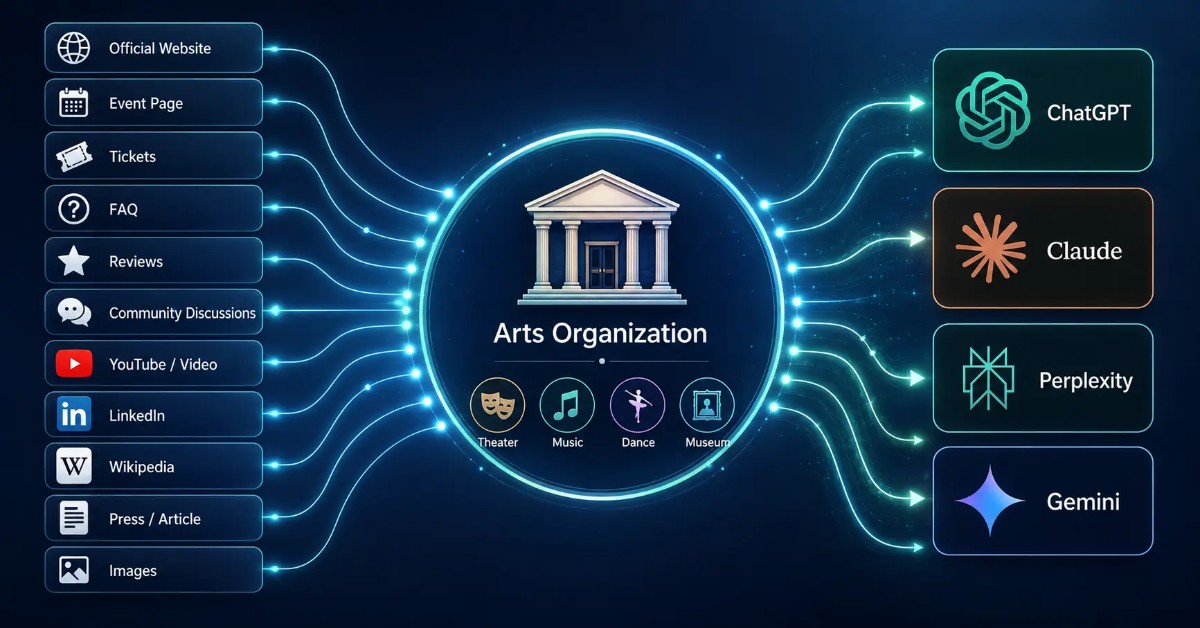
Read the national research back as a specification and it describes a fairly specific channel. Newcomers want a new experience but need something recognizable. They research before they buy. They differ from your existing audience behaviorally, not just in age. They're willing to recommend and rarely asked. And the ones who return are already engaged with the performing arts more broadly.
That last finding is the one that matters most here, because it identifies your most convertible prospect: someone who already attends theatre, dance or concerts, and has simply never attended opera. They are not on your list. They are, by definition, the audience of a cross-disciplinary cultural discovery platform — which is what CultureOwl is. There's a fuller breakdown for classical music and opera organizations, but mapped against the findings:
Reaches arts-engaged people who don't attend opera — the returning-newcomer profile the research describes, browsing by interest, location and intent rather than searching for you by name.
Carries the pre-visit material they're already looking for. If newcomers watch and listen before buying, that research is happening somewhere. Event pages, editorial and organization profiles put it where they're deciding rather than leaving it to chance.
Gives the recognition half of the equation somewhere to live — the story, the context, why the title is one they half-know — which a ticket page never has room for.
Turns willingness to recommend into a mechanism. People can follow your organization and share what they're going to, so the referral intent the research found has somewhere to go.
Builds an audience you can contact again, so a first visit becomes a relationship — and the second-visit offer that cost data argues for can actually be targeted.
Email, social and editorial in one place, including the local community reach you'd otherwise chase through neighborhood groups and calendars one at a time.
Ads that complement Meta rather than replace it — additive local reach, not a substitute.
Insights on your own pages — who engaged, what they followed, which productions drew genuinely new attention. This is how you find out whether your newcomers really do differ from your list, instead of assuming it.
Banner placement and reserved-seat ticketing if you want them, so promotion and checkout aren't disconnected systems — which is what makes the new-buyer numbers above traceable in the first place.
The consolidation matters as much as any single feature. Most companies run discovery, email, social, ads and ticketing across tools that don't share data — which is precisely why the numbers above are so hard to produce.
What stays outside any platform is the one-to-one work: the corporate buyer who needs a named contact, the coach operator who needs a contract. Everything broader is reachable from one place, which is the difference between running a multi-channel strategy and intending to. Fuller picture on our event promotion pages.
Frequently asked questions
How should opera companies price tickets for new audiences?
Price is rarely what stops a first visit — uncertainty is. Cost matters far more at the second and third visit, so entry offers that expire after one purchase solve the wrong half of the problem. Use targeted offers by segment rather than broad discounts that subsidize people who would have paid full price.
Are tourists worth marketing to for an opera company?
Often significantly. Opera Australia's Handa Opera on Sydney Harbour draws roughly 15,000 travelers annually. Tourists are actively seeking things to do and unusually willing to spend, but they are reached through visitor bureaus, hotels and destination discovery rather than through arts channels — and on a different buying clock than your season audience.
Key takeaway
Opera marketing improves fastest not by finding better channels but by admitting there is no average customer. The core attender, the social attender, the tourist and the corporate buyer want different things, arrive through different doors and are lost for different reasons. Name the segment first, and every other decision — positioning, packaging, channel, price, measurement — gets easier and cheaper.
For the broader system this sits inside, see our guide to marketing arts and cultural events, and for the longer-term relationship work, audience development strategies for arts organizations.