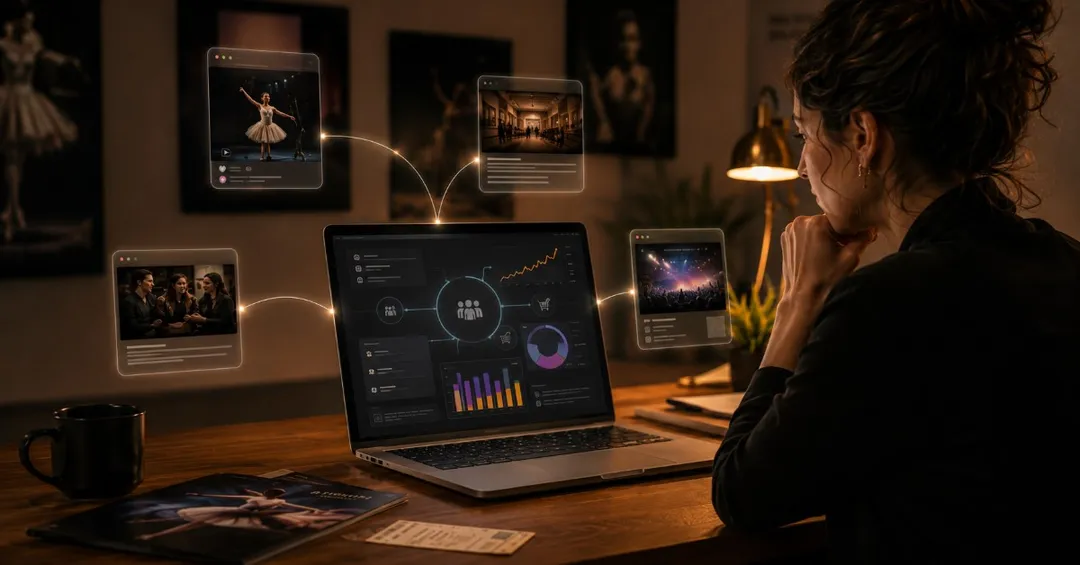

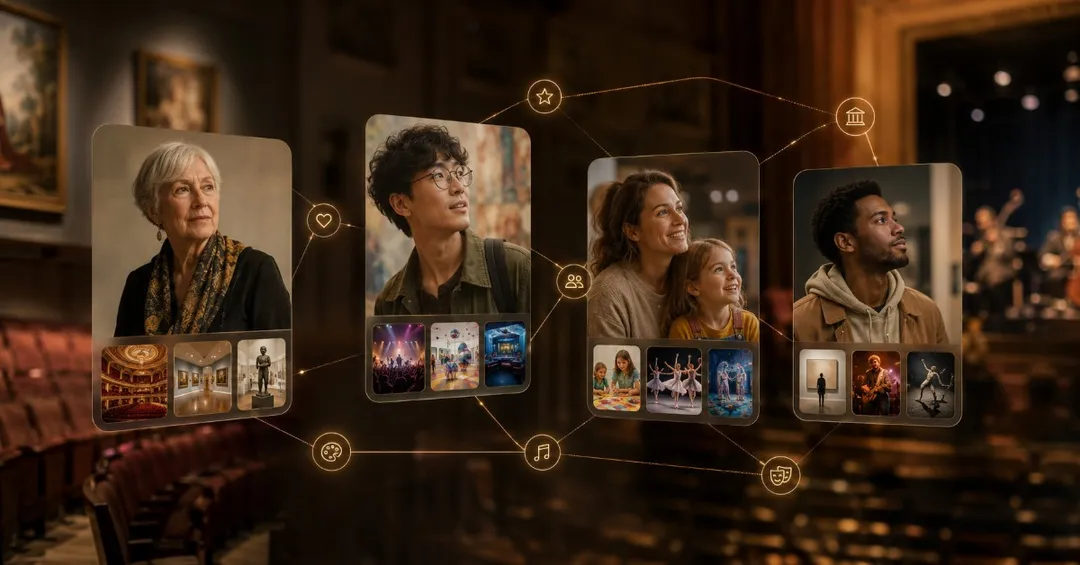
The strongest audience personas for arts organizations are built around motivation, why someone actually shows up, socializing, learning, unwinding after work, not around demographics like age or income. Research on arts audiences consistently finds that grouping by motivation outperforms demographic slicing, because two people of the same age and income can be attending for completely different reasons, and it's the reason, not the age bracket, that determines what message actually moves them. Most arts organizations need three to five personas, built from real attendance data, not invented from assumption.
How to Create Audience Personas for Arts Organizations
Most arts organizations know who bought a ticket. Far fewer know what those people were hoping for, what almost stopped them from attending, or what might bring them back.
That is where audience personas become useful. A strong persona helps an organization move beyond broad labels and understand the motivations, concerns, habits, and decision patterns shaping participation.
Audience personas for arts organizations should be built from real behavior and direct audience input—not fictional biographies, stock photos, or assumptions about age and income. When done well, they can improve campaign language, event information, programming, outreach, and the overall audience experience.
To build one, start with a specific decision, choose a priority audience group, review the data you already have, speak directly with people, identify recurring patterns, and turn those findings into a concise profile your team can use and test.
The person represented in the persona may be fictional. The evidence behind the profile should not be.
What Is an Audience Persona?
An audience persona is a research-based profile representing audience members who share meaningful behaviors, motivations, needs, barriers, or decision patterns.
A useful persona should help your team understand more than who purchased a ticket. It should explain:
What the audience is hoping to experience
What information they need before deciding
What may prevent them from participating
What makes an event feel relevant
What could encourage them to return
Personas can be informed by ticket purchases, attendance history, website activity, email engagement, surveys, interviews, box-office observations, and conversations with current or prospective audiences.
They should not be built around invented details that have no effect on participation. A fictional job title, favorite restaurant, or list of hobbies may make a profile appear complete without making it useful.
Include personal information only when it affects how someone discovers, evaluates, attends, or experiences cultural programming.
Target Audience vs. Audience Segment vs. Audience Persona
These terms are connected, but they do different jobs.
Term | What it means | Arts example |
|---|---|---|
Target audience | The broader public an organization wants to reach | Local adults interested in cultural experiences |
Audience segment | A measurable group sharing identifiable data or behavior | First-time theater buyers who have not returned |
Audience persona | A research-based profile explaining motivations, needs, and barriers | A curious newcomer who wants context but worries about choosing the wrong event |
A target audience establishes general direction.
<u>Audience segmentation for arts organizations</u> identifies groups that can be found in a ticketing system, CRM, analytics platform, or campaign report.
A persona adds human context.
For example:
Audience segment: First-time buyers who have not returned within six months.
Persona insight: Some enjoyed their first event but do not know what to attend next. The organization’s event descriptions may also assume more familiarity with the art form than those attendees possess.
The segment identifies who may need a different approach. The persona helps determine what that approach should consider.
Before creating personas, make sure your organization has begun to <u>identify its target audience</u> and define the measurable groups connected to its goals.
Why Demographics Are Not Enough
Age, location, income, and family structure can provide useful context. They may affect affordability, transportation, scheduling, accessibility, and program relevance.
The problem begins when those characteristics become the central idea of the persona.
Consider three audience members who are the same age, live in the same ZIP code, and have similar incomes:
One wants an enjoyable night out with friends.
One wants to learn about an unfamiliar artist or subject.
One wants a quiet break from work and everyday responsibilities.
Their demographic profiles may look nearly identical. What motivates them to attend—and what information helps them decide—could be very different.
Use demographics when they affect the decision. Build the persona around what someone is trying to experience, accomplish, or avoid.
How to Build an Audience Persona
1. Start With the Decision
Do not begin by asking:
Who is our audience?
That question is too broad to produce a useful working profile.
Begin with a specific decision:
How can we encourage first-time attendees to return?
What prevents local families from participating?
How should we introduce an unfamiliar production?
What would make weekday performances more appealing?
What information would help new museum visitors feel prepared?
How can we reach audiences who show interest but never purchase?
The decision gives the persona a purpose.
A profile designed to improve first-time buyer retention will look different from one created to increase class enrollment, reach nearby families, or introduce audiences to unfamiliar programming.
2. Choose a Priority Audience Group
Select an audience group directly connected to the decision.
That group might include:
Recent first-time attendees
Frequent single-ticket buyers
Lapsed members
Family-program participants
Free-event attendees who have not purchased tickets
Class participants who have not attended other programming
Website visitors who repeatedly view events without purchasing
Residents from a community the organization hopes to reach
Avoid trying to create personas for every buyer, member, student, donor, volunteer, and visitor at once.
Start with the audience group connected to your most immediate goal.
3. Review the Data You Already Have
Look across the systems your organization currently uses.
Relevant information may include:
First event attended
Programs or genres selected
Ticket quantity
Purchase timing
Attendance frequency
Price points
Membership or class participation
Email and event-page engagement
Discovery or referral source
Survey responses
Box-office questions
Refund or exchange reasons
Before building a profile, determine <u>what audience data arts organizations should track</u> and make sure the information is organized consistently.
Behavior shows what someone did. It may suggest why, but it rarely proves motivation on its own.
An attendee who repeatedly purchases two tickets may value a shared experience. Those tickets could also be for a family member, colleague, caregiver, or changing group of friends.
Treat behavioral patterns as questions to investigate rather than conclusions.
4. Speak Directly With the Audience
Ticketing records can show what happened. Conversations help explain what the experience meant to the person making the decision.
Ask questions such as:
What first caught your attention?
What were you hoping the experience would be like?
What information did you look for before deciding?
What nearly prevented you from attending?
Who else was involved in the decision?
What made the experience feel comfortable or uncomfortable?
What would make returning more likely?
Where do you usually discover things to do?
How would you describe the experience to a friend?
Avoid leading questions.
Instead of asking:
Did the ticket price make it difficult to attend?
Ask:
Was there anything that made the decision difficult?
Staff observations can contribute useful context, but they should not replace direct audience input.
5. Identify Meaningful Patterns
Compare what audience members said with what they did.
Look for recurring patterns involving:
Motivation
Desired experience
Attendance behavior
Barriers
Questions or uncertainties
Decision triggers
Discovery habits
Reasons to return
Reasons not to return
Do not create a separate persona for every difference.
Two audience members may have different ages, occupations, and neighborhoods but share the same central need: an enjoyable cultural night out that does not require extensive planning or prior knowledge.
Create a separate persona only when the difference would meaningfully change the message, offer, channel, event information, experience, follow-up, or barrier being addressed.
If two personas would receive the same communication and experience, they may not need to remain separate.
6. Build a Concise, Evidence-Based Profile
A working persona should generally fit on one page.
Use a memorable behavioral name such as:
The Curious Newcomer
The After-Work Connector
The Creative-Enrichment Parent
The Deep-Dive Regular
A behavioral name is often more useful than a fictional biography such as “Sarah, 42, Marketing Director.” It keeps the team focused on the person’s relationship with the experience.
Most importantly, separate what you know from what you think may be true.
Finding | Evidence status |
|---|---|
Purchased two weekday tickets three times | Observed behavior |
Wants an experience to share with a friend | Reported during interviews |
May be motivated by social connection | Working hypothesis |
Staff believes parking may be a concern | Assumption requiring validation |
A hypothesis is not a failure. It is an honest statement about what still needs to be tested.
7. Use the Persona and Measure the Result
A persona becomes valuable only when it changes a decision.
It might influence:
Campaign language
Email subject lines
Event-page descriptions
Images and video
Ticket packages
Parking and arrival information
Program recommendations
Post-event communication
Then measure what happens.
Depending on the objective, useful measures might include event-page engagement, email clicks, ticket purchases, registrations, second-event purchases, or return attendance.
Your organization should be able to complete this sentence:
Because of what we learned about this audience, we changed __________, and we will measure __________.
For example:
Because first-time museum visitors told us they were uncertain about how to approach the exhibition, we added a short introduction and a suggested first-visit route, and we will measure engagement with those resources and return visits.
Download the Audience Persona Template
The CultureOwl Audience Persona Template provides a structured place to document audience behavior, motivations, barriers, discovery habits, decision triggers, evidence sources, and the next action your organization hopes to encourage.
The editable worksheet also includes space to identify assumptions that still need to be tested, assign an owner, and set a review date.
CultureOwl_Audience_Persona_Template.pdf
Audience Persona Example: The After-Work Connector
Decision to improve: Increase repeat attendance for weekday programming.
Measurable audience group: Adults who purchased two weekday tickets once or twice during the past year.
Observed behavior: They usually purchase within two weeks of the event, select evening programming, and buy two tickets.
What interviews reveal: They want a shared experience with a friend or partner that feels more memorable than the usual restaurant or bar. They are interested in culture but do not want the evening to require extensive preparation.
Desired experience: An enjoyable, culturally interesting, and manageable evening after work.
Barriers:
Unclear run times
Parking uncertainty
Unfamiliar programming
Overly academic descriptions
Concern that prior knowledge may be expected
What helps them decide:
Clear start and end times
Plain-language event descriptions
Parking or transportation information
Images that communicate the atmosphere
A direct explanation of what makes the experience worth choosing
Next desired action: Purchase another weekday event within three months.
Evidence: Ticketing data and interviews with recent attendees.
Assumption to test: Whether clearer planning information increases purchases.
Should Arts Organizations Create Personas for Non-Attendees?
Yes—especially when the objective is audience growth.
Ticketing and membership data primarily describe audiences already represented in your systems. They cannot fully explain the needs, perceptions, or barriers of those who have never attended.
Prospective audiences may be researched through:
Community listening sessions
Interviews through partner organizations
Surveys of local residents
Feedback from free or off-site programs
Conversations with audiences who considered attending but did not purchase
Research involving abandoned event pages or checkout processes
Do not invent a community’s motivations during an internal meeting. Invite members of that community into the research process.
How Many Audience Personas Should You Create?
For many organizations, three to five active personas is a practical starting range. A smaller organization may begin with two.
The real limit is not how many profiles fit in a presentation. It is how many the team can understand and use.
If two personas would receive the same message, offer, and experience, consider combining them.
Personas should also be reviewed over time. Audience behavior, barriers, programming, and discovery habits can change.
Common Audience Persona Mistakes
Avoid:
Inventing a persona before reviewing evidence
Treating one purchase or click as proof of motivation
Filling profiles with irrelevant demographic details
Confusing personas with measurable segments
Creating personas only for loyal attendees
Creating so many personas that teams cannot use them
Treating personas as permanent
Producing a document that never affects the work
Personas should appear in campaign briefs, planning meetings, event-page reviews, and post-campaign evaluations—not only in a shared folder.
Frequently Asked Questions
What makes a good audience persona for an arts organization?
A good persona is based on real evidence and explains the audience group’s behavior, motivations, desired experience, barriers, discovery habits, and decision triggers. It should improve a specific marketing, programming, or audience-experience decision.
Should audience personas include demographics?
Include demographic information when it affects affordability, access, scheduling, communication, relevance, or the experience. Do not use demographics as a substitute for understanding motivation.
Can personas be created without surveys?
Yes. Interviews, listening sessions, ticketing behavior, box-office feedback, and community-partner conversations can all contribute. Direct audience input should still be included whenever possible.
What is the difference between an audience segment and a persona?
A segment is a measurable group defined by shared data or behavior. A persona provides research-based context about the motivations, needs, and barriers that may exist within that group.
How often should personas be updated?
Review personas when audience behavior changes, new research challenges an assumption, or the profile no longer leads to distinct decisions. Each persona should have an owner and review date.
Turn Audience Understanding Into Audience Growth
Audience personas become valuable when they change how an organization communicates, promotes programming, or removes barriers to participation.
Begin with real behavior. Speak directly with audiences. Ask what they hoped to experience, what helped them decide, and what got in the way. Build a concise profile around the patterns that matter, and clearly identify anything that remains an assumption.
CultureOwl helps arts organizations apply those insights across event discovery, email, social media, cultural stories, featured visibility, and ticketing. A coordinated <u>event promotion strategy for arts organizations</u> helps different events reach audiences based on relevance instead of receiving the same broad promotional approach.