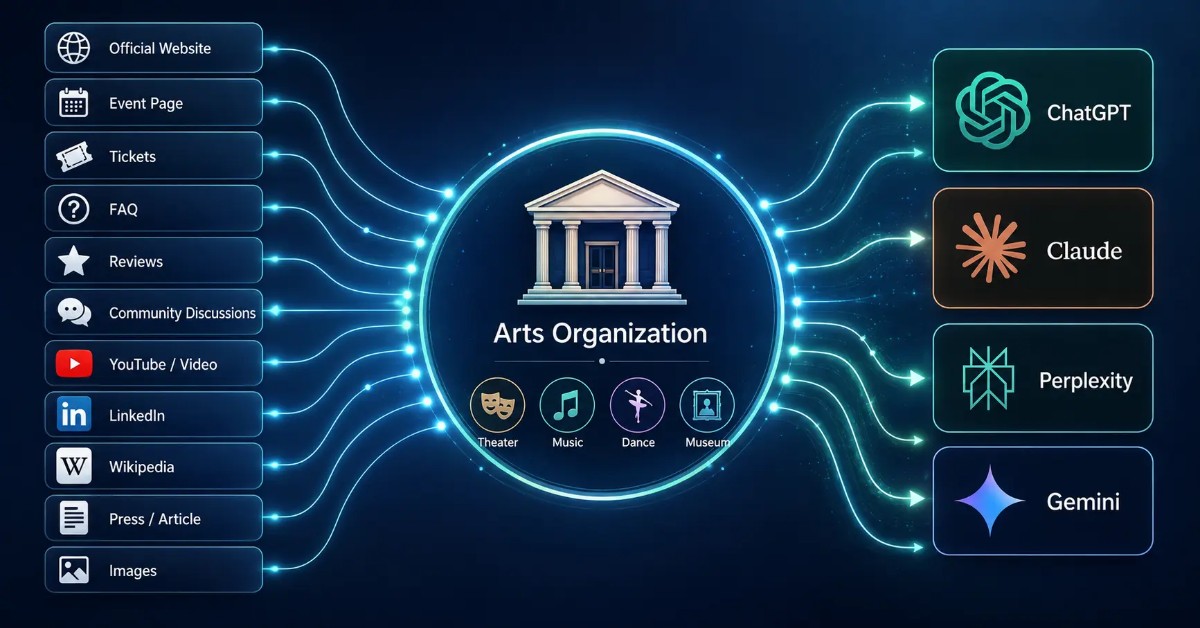


A one-person arts marketing department has five promotion levers that hold up: the existing email list, paid social, listing and discovery platforms, local press, and audience swaps with partner organizations. Each costs something different in money and staff hours, and two outside numbers change how they rank: nonprofits lose about 16% of their email subscribers every year (M+R Benchmarks), and almost 40% of US local newspapers have disappeared in two decades (Medill).
Take a 300-seat theater with one part-time marketer, a fixed email list, a Facebook page, and six productions a year to fill. The constraint is hours, not ideas. The same person writes the season copy, sends the emails, posts to social, and often returns the box office voicemail. Every option below is judged on two costs: the money it takes, and the hours it takes from everything else that person does.
The marketing cost that rarely gets counted
The ticketing fee is the first promotion cost an organization pays, and it is usually filed under operations. As of October 2026, Eventbrite's US organizer pricing page lists a service fee of 3.7% plus $1.79 per paid ticket, plus a 2.9% payment processing fee per order.
On a $45 ticket, the service fee is about $3.46, or 7.7% of face value. If the organization absorbs fees, processing adds about $1.31, for roughly $4.76 per ticket. Across 1,000 tickets, that is $3,455 in service fees and about $4,760 with processing. A flat $0.99 platform fee on the same 1,000 tickets is $990, before processing. The $2,465 gap in platform fees alone is the size of a modest season budget for paid social.
The fee is also now visible in every price a buyer sees. Since May 12, 2025, the FTC's Rule on Unfair or Deceptive Fees has required businesses that advertise live-event ticket prices to show the total price, including mandatory fees, more prominently than other pricing information. A high per-ticket fee is no longer a checkout surprise; it sits in the headline price on every listing and ad.
Any fair comparison counts processing on both sides, because a side-by-side of service fees alone flatters whichever vendor charges more for processing. The processing-adjusted numbers are on the ticketing platform comparison page, and the structural argument is in flat vs. percentage-based ticketing fees.
Five promotion options, each given its best case
Each option below is a choice some arts organizations make on purpose. No named dataset measures staff time for small arts organizations, so time is described as the work involved rather than estimated.
Email the existing list and change nothing
This is the default, and often the right one. It costs nothing beyond the existing email tool, needs no setup, and takes a few sends per production. For an organization whose list already fills most runs, it can be enough.
What it gives up is growth, and the list does not stand still. In M+R Benchmarks' 2026 study of nonprofits (covering 2025), 4% of start-of-year subscribers became unreachable through bounces and another 12% unsubscribed. Lists still grew 5% on average, which means the typical nonprofit had to sign up new subscribers equal to roughly a fifth of its list to end the year 5% ahead. The figures are cross-sector, not arts-specific, but the direction holds: a list that is not fed from outside shrinks.
Paid social
Paid social on Facebook and Instagram buys reach to people who have never heard of the organization. There is no fixed price; spend is whatever budget the organization sets, sold at auction. Its best case is targeting by location and interest, live within days. It suits an organization with a budget line approved before the season announcement and someone who can check results weekly.
What it gives up: reach stops when spending stops, and Meta reports clicks and platform-attributed conversions, not a confirmed count of tickets sold. What separates ads that sell tickets from ads that collect likes is covered in how to build ads that actually sell tickets.
Listing platforms and discovery calendars
A listing on a local calendar or discovery platform reaches people already looking for something to do, the audience an email list cannot reach. Terms vary by platform. Staff time is mostly entering events and keeping dates current, which adds up across six productions.
What it gives up: the event sits beside every other event on the page, and the organization does not control how it is presented. A listing alone also rarely builds a lasting audience; the reasons are in why event listings alone do not create audience growth.
Local press and editorial coverage
A preview costs no money and carries more trust than an ad. The work is a release, good photos, and enough lead time for the outlet's schedule. It suits productions with a story beyond "we have a show": a premiere, a local artist, an unusual venue.
The supply is shrinking. Northwestern Medill's State of Local News 2025 report found that almost 40% of US local newspapers, close to 3,500 papers, have vanished over the past two decades, and fewer than 1,000 daily print newspapers remain. Fewer outlets means fewer preview slots, which makes press a selective tool rather than a per-production routine. Editors also control timing and angle, and coverage can run after closing or not at all.
Partnerships and audience swaps
Two organizations with overlapping audiences promote each other's events, each to its own list. It costs no money and takes coordination hours instead. The working version swaps a mention, not the list, so no personal data changes hands. A unique promo code for each partner counts how many of that partner's audience bought.
What it gives up: every send about a partner's event is a send not used for the organization's own, and lists tire of it if it happens monthly. The relationship mechanics are in the theater partnership playbook.
Tradeoffs side by side
Email the existing list: Money: Existing email tool only. Staff time: A few sends per production; no setup. Suits: Organizations whose list already fills most runs. Gives up: Growth; the list loses subscribers every year.
Paid social: Money: Set by the advertiser; auction-priced. Staff time: Setup, then weekly checks while ads run. Suits: Organizations with a pre-approved budget line. Gives up: Reach ends when spend ends; no confirmed ticket count.
Listing platforms: Money: Varies by platform. Staff time: Event entry and date upkeep per production. Suits: Organizations trying to reach new attendees. Gives up: Control of presentation; competition on the page.
Local press: Money: None. Staff time: Release, photos, lead time. Suits: Productions with a story beyond the show itself. Gives up: Control of timing and angle; fewer outlets.
Audience swaps: Money: None. Staff time: Coordination with each partner. Suits: Organizations with a non-competing partner nearby. Gives up: Sends to the organization's own list; list fatigue.
A workable order for one person: keep email as the base, add listings and one partner swap per production, pitch press only for productions with a real story, and treat paid social as the one line that needs a budget decision before the season, not halfway through. An organization whose list already sells out most runs should change nothing and spend the hours elsewhere. For what happens after the click, see how to sell more tickets for arts events.
How CultureOwl fits in
CultureOwl is event discovery with low-cost ticketing, built for the arts. Events are listed where people browse across multiple markets, which covers the listing option above, and tickets can be sold from the same listing. The platform fee is a flat 99¢ per paid ticket, with payment processing charged separately and no percentage fees. Partner swaps can run on per-partner promo codes, and sales export to CSV. It does not tell anyone which social post sold which ticket. More on event ticketing software for arts organizations.
Frequently asked questions
What is the most efficient event promotion channel for a one-person arts marketing team?
The existing email list, because it needs no setup and reaches people who already buy. M+R Benchmarks data shows nonprofit lists lose about 16% of subscribers a year to bounces and unsubscribes, so email works best paired with at least one channel that reaches new people.
How much does Eventbrite charge on a $45 ticket?
As of October 2026, Eventbrite's US pricing is 3.7% plus $1.79 per paid ticket, plus 2.9% processing per order. On a $45 ticket, that is about $3.46 in service fees, or roughly $4.76 including processing if the organization absorbs fees.
Do ticketing fees have to be shown in advertised prices?
Since May 12, 2025, the FTC's Rule on Unfair or Deceptive Fees has required businesses advertising live-event ticket prices to display the total price, including mandatory fees, more prominently than other pricing information.
How can a small arts organization track which promotion sold tickets?
Use a separate promo code for each partner or channel. Paid social platforms report attributed conversions, but no channel gives a confirmed count of which organic post sold which ticket.
Key takeaway
For a one-person department, promotion is a budget of hours. Email is the cheapest base but loses about a sixth of its subscribers each year, and local press offers fewer slots every year, so the channels that reach new people, listings, partner swaps, and a planned paid social line, carry more weight than they used to. Ticketing fees belong in the same budget: on 1,000 tickets at $45, the gap between Eventbrite's service fee and a flat 99¢ fee is $2,465 before processing.
Sources: Eventbrite organizer pricing page (US), as of October 2026; Federal Trade Commission, Rule on Unfair or Deceptive Fees (16 C.F.R. Part 464); M+R Benchmarks 2026, Email Messaging; Northwestern Medill Local News Initiative, The State of Local News 2025. Fee arithmetic is CultureOwl's, based on Eventbrite's published rates.