


Ticketing fees matter because they determine how much revenue remains with the organization after the sale.
But the fee comparison begins late in the customer journey. Before anyone reaches checkout, the event has to be discovered, understood, and chosen.
A low-cost ticketing tool may process transactions efficiently while contributing little to event visibility. The organization still has to generate every visit through its own website, email list, social channels, partnerships, and advertising.
A stronger model helps create demand before the transaction and protects the producer’s revenue after it.
CultureOwl combines cultural event discovery and promotional opportunities with a flat 99¢ platform fee per paid ticket. The fee does not increase when an organization charges more for premium seating, passes, classes, packages, or higher-value programming.
Comparing 99¢ With 75¢ Plus 3%
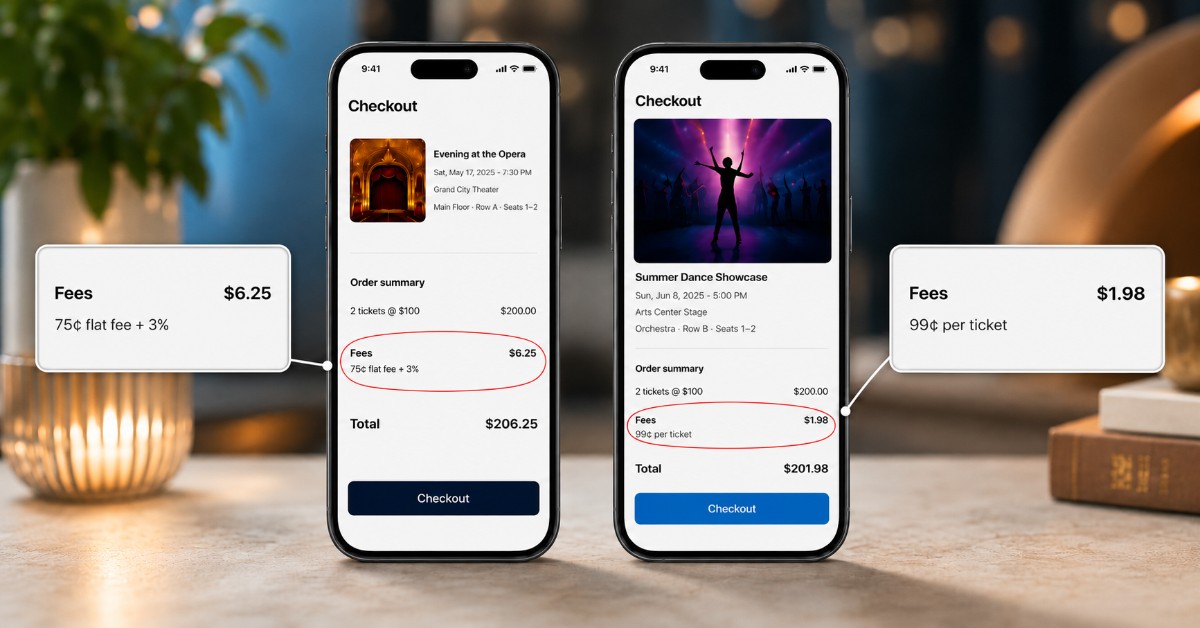
For this comparison, we are using an illustrative platform fee of 75¢ plus 3% of the ticket price.
Payment processing is separate from the platform fees shown.
The two models are equal at an $8 ticket price. Above $8, the 99¢ fee is lower, and the difference grows with the ticket price.
At $20, the gap is modest. At $50 or $100, particularly across a full run, festival, class series, or season, it becomes meaningful operating revenue.
Replace everything from “Percentage Fees Monetize the Producer’s Pricing” through “Key Takeaway” with this tighter version:
Percentage Fees Rise With the Producer’s Pricing
A percentage-based fee increases whenever the producer raises the ticket price.
That higher price may reflect a major artist, a larger venue, greater production costs, accessibility services, a multiweek class, or a package containing several events. The organization creates that value and assumes the financial risk, but the platform automatically receives more.
A $100 ticket does not necessarily require five times as much ticketing infrastructure as a $20 ticket. Flat pricing separates the platform charge from the producer’s pricing strategy.
Ticket Revenue Is Not Profit
Percentage fees are calculated from gross ticket revenue before the organization pays artists, venues, production staff, marketing, insurance, licensing, accessibility, and other operating costs.
For many nonprofit cultural organizations, a higher ticket price reflects a more expensive program—not a larger profit margin.
This is revenue-sharing, not profit-sharing. The producer carries the creative and financial risk while the platform receives more whenever the ticket price rises.
The Difference Across a Real Ticket Mix
Most organizations sell several types of tickets.
A theater may offer $25, $50, and $85 seats. At 75¢ plus 3%, the platform fees would be $1.50, $2.25, and $3.30. With CultureOwl, each platform fee remains 99¢.
The same issue applies to premium seating, multiweek classes, festival passes, season packages, and other higher-value offers. The price reflects more programming for the attendee, but not necessarily more work for the ticketing platform.
Passing the Fee to the Buyer Does Not Remove It
When an organization absorbs the fee, it reduces net revenue. When the attendee pays it, it raises the total purchase price.
Either way, the fee affects the transaction.
Since May 12, 2025, the FTC’s Rule on Unfair or Deceptive Fees has required live-event ticket sellers to display the total mandatory price upfront. The rule does not prohibit ticketing fees; it requires them to be clear.
Compare the Complete Cost
CultureOwl’s 99¢ charge is the platform fee. Payment processing is separate.
Organizations should compare the complete cost of selling tickets, including platform and processing fees, per-order charges, subscriptions, equipment, refunds, optional services, and payout terms.
They should also consider how people actually buy. A per-ticket charge and a per-order charge can produce very different results for couples, families, groups, and subscribers purchasing several events.
Ticketing Cost Includes Audience Acquisition
The cheapest checkout is not necessarily the least expensive ticketing strategy.
A basic platform may charge a low fee while requiring the organization to generate every visit through advertising, email, social media, partnerships, public relations, and staff time.
Those costs belong in the comparison.
The complete path is:
Discovery → promotion → event page → purchase → audience relationship → repeat attendance
A platform that participates only at checkout leaves the organization to fund everything that comes before it. This is why event listings alone do not create audience growth.
Discovery Changes the Value of the Fee Model
CultureOwl combines event ticketing software for arts organizations with cultural discovery and promotion. The 99¢ fee is one part of that larger model—not a stand-alone discount ticketing offer.
People visit CultureOwl to find performances, exhibitions, festivals, classes, venues, and cultural organizations. Members can also give priority events additional visibility through CultureOwl-managed digital ads, social media, email, banners, and select editorial coverage.
Event Discovery vs. Event Promotion explains why ongoing visibility and active event promotion solve different problems.
A Flat Fee Protects the Value Created by Promotion
Every ticketing platform earns more when more tickets are sold.
Under a percentage model, however, the platform also earns more when the producer raises the ticket price. It benefits from both higher volume and higher ticket values.
With CultureOwl, the platform fee remains 99¢. Increased sales generate more fees because more tickets were processed—not because the organization created a more valuable offer.
That allows more of the revenue generated through discovery and promotion to remain with the producer.
The Sale Should Support a Continuing Relationship
Ticketing value does not end with the transaction.
When someone buys from a CultureOwl member, the member can access the customer information associated with its own ticket buyers, subject to applicable permissions and privacy requirements.
CultureOwl’s broader audience supports discovery and promotion. The organization’s purchaser relationships support follow-up, relevant recommendations, and repeat attendance.
A completed transaction has value. A customer relationship that continues is worth more.
Platform Value Extends Beyond Price
Organizations should also consider whether the platform supports their real programming needs, including reserved seating, timed entry, classes, passes, packages, discounts, and built-in donation capability alongside ticket sales.
Event-page quality, mobile checkout, reporting, purchaser access, organization visibility, and promotional support all affect the platform’s overall value.
A low fee is less useful if the platform contributes nothing to discovery or limits how the organization sells its programming.
CultureOwl’s Public-Benefit Model
CultureOwl is a public benefit corporation built to strengthen the cultural ecosystem.
The platform helps organizations increase visibility, promote events, sell tickets, and build relationships with their buyers—without taking a larger percentage as ticket prices or attendance grow.
The goal is a healthier economic relationship among CultureOwl, cultural producers, and their audiences.
Key Takeaway
At ticket prices above $8, CultureOwl’s 99¢ platform fee costs less than 75¢ plus 3%.
At $20, the difference is 36¢ per ticket. At $50, it is $1.26. At $100, it is $2.76. Across hundreds or thousands of tickets, those differences become meaningful revenue.
But fees should not be judged alone.
The strongest platform also helps people discover the event, understand the organization behind it, purchase easily, and remain connected afterward.
CultureOwl helps drive the sale through discovery and promotion. The flat fee helps more of that revenue remain with the organization creating the experience.