The Sound Inside Us: How Music Rewires the Mind and Restores the Soul
The Brain on Music
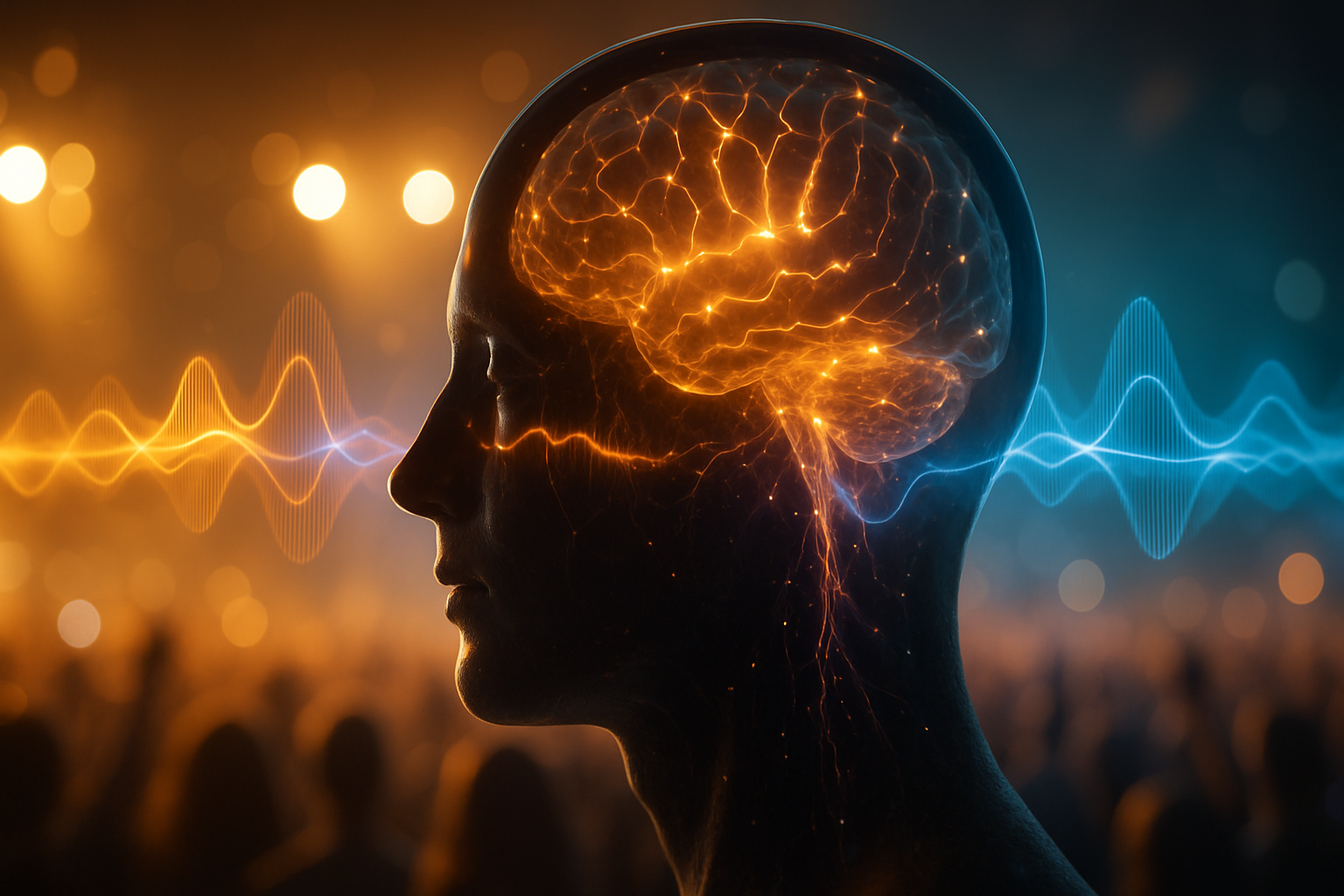
It starts before the lyrics. Before rhythm, even — that primal spark when sound meets synapse. The human brain doesn’t simply hear music; it inhabits it. Neural pathways light up like a constellation in motion — emotion, memory, movement, even the regions responsible for empathy. Music, neuroscientists tell us, engages more of the brain than any other human activity.
When we listen, the auditory cortex decodes pitch and rhythm, while the hippocampus links melodies to memory. The limbic system floods with dopamine — the same neurotransmitter that fuels pleasure, motivation, even love. This is why a single song can transport us back to a childhood summer or make a morning commute feel cinematic. Music isn’t just a soundtrack to life; it’s a biological collaboration between physics and feeling.
The Language of Frequencies
Every note vibrates at a specific frequency, and our brains are exquisitely attuned to those invisible waves. Low frequencies — think basslines, drums, the hum of a cello — resonate with our physical selves. They can slow the heart rate, deepen breath, and evoke grounding emotions like calm or power.
Higher frequencies — the treble shimmer of violins, flutes, or a singer’s upper range — activate the cerebral and emotional centers, stimulating focus and elation. It’s no wonder spa playlists lean on 432 Hz (a frequency thought to induce relaxation), while workout mixes pulse closer to 440 Hz, energizing the body’s natural tempo.
Different genres, too, carry distinct neurological fingerprints. Classical compositions can boost spatial reasoning and memory retention — the so-called “Mozart effect.” Jazz improvisation has been shown to enhance creative thinking by loosening inhibition in the prefrontal cortex. Ambient electronica may lower cortisol levels, while upbeat pop syncs brainwave patterns with rhythm, triggering physical movement and mood elevation.
Emotional Architecture
Yet the science only tells half the story. The other half belongs to the heart. Music constructs emotional architecture — invisible cathedrals where we process joy, grief, longing, and release. It’s why we hum lullabies to infants, sing hymns in mourning, or belt out breakup songs with the windows down.
These rituals are ancient. Early humans likely used rhythm to communicate safety or gather for ceremonies long before language evolved. The drumbeat, the chant, the chorus — all were evolutionary glue. When we share music, our bodies literally synchronize: breathing patterns, heart rates, and even neural oscillations begin to align. The science calls it entrainment. Most of us just call it connection.
The Magic of Being There
For all the algorithms and streaming playlists in the world, nothing rivals the physiological and emotional charge of live music. Standing shoulder-to-shoulder in a crowd, you don’t just hear sound — you feel it, a pulse that travels through air and bone.
Studies show that attending live performances increases oxytocin (the “bonding” hormone) and reduces stress markers. Heart rates synchronize across audiences, creating what researchers describe as a temporary “social heartbeat.” It’s biology turned into community.
There’s also something ineffable — that electric uncertainty of the moment. Maybe the guitarist stretches a solo longer than usual. Maybe the singer falters, laughs, recovers. That imperfection, that shared humanness, is what makes live music not just sound, but story.
When Science Meets Soul
If we strip it down, music is simply organized vibration. Yet within that vibration lies the architecture of our emotional and social selves. Frequencies shape mood; rhythms regulate biology; melody binds memory. But what makes it transcendent is how those mechanisms translate into feeling — how physics becomes poetry.
In that sense, music is both the most universal and the most personal art form. A Bach cello suite and a Kendrick Lamar verse operate on the same physical laws, yet they reach us differently because of who we are, where we’ve been, and what we need.
Maybe that’s why no two people ever hear the same song the same way.
The Ongoing Experiment
Every concert, every playlist, every improvised hum in the shower is a small neurological experiment — a conversation between sound and self. So the next time you feel goosebumps during a crescendo or tears during a quiet refrain, know this: that’s your brain’s chemistry conducting its own symphony.
And if you really want to understand what music can do to your mind — don’t just listen. Go. Stand in the crowd, let the bass vibrate through your ribs, let the treble spark behind your eyes. Let your brain and body remember that they’re both instruments too.
Similar Posts

Dior and SCAD: Inside a Rare Collaboration Between Fashion House and Art School
Balloon Museum Expands Its Global Tour With POP AIR – Art Is Inflatable

A love letter in couture: Dolce&Gabbana at ICA Miami
When the Body Carries the Argument: What Makes a Dance Performance Great

The Joy of Sitting in the Front Row at a Small Theater
The Unspoken Magic of Opening Nights

10 Cities That Belong on Every Cultural Traveler’s Bucket List

Funding the Arts at Home, Pulling Back Abroad

Artists Are Not Being Replaced by AI—And the Fear Misses the Deeper Truth

New World School of the Arts Alum Leonardo Castañeda Selected for the 2026 Whitney Biennial

Crossroads of Culture: Highlights from Art Basel Miami Beach 2025