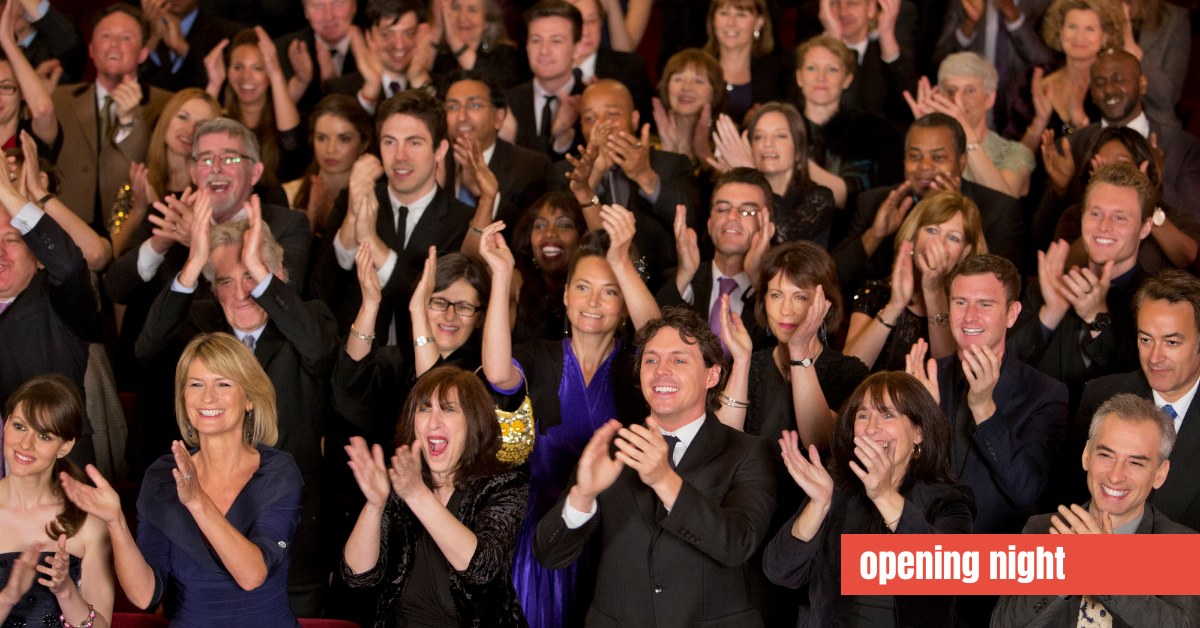
Opening nights are not about celebration. They are about exposure.
By the time an audience arrives, months, sometimes years of labor sit behind the curtain or hang on the wall. But opening night is the first moment that work no longer belongs solely to its creators. It enters public negotiation. And that transition is more consequential than most people admit.
We tend to romanticize premieres as glamorous affairs. Historically, they have often been volatile, decisive, and sometimes brutal. The 1913 premiere of Stravinsky’s The Rite of Spring at the Théâtre des Champs-Élysées famously dissolved into shouting and near-riot, yet that very rupture secured its place in modernism’s canon. Henrik Ibsen’s Ghosts (1882) was condemned as immoral and “loathsome” on opening, only to become central to modern drama. Fast-forward to Broadway: Stephen Sondheim’s Merrily We Roll Along closed after just 16 performances in 1981, its opening-night reception sealing its commercial fate, though decades later it would be revived and critically rehabilitated. By contrast, A Chorus Line (1975) opened to ecstatic reviews and audience word-of-mouth that turned it into one of the longest-running shows in Broadway history. Hamilton (2015) entered opening night with anticipation, but the immediate critical consensus amplified its cultural reach almost overnight.
Opening night does not guarantee legacy, but it accelerates trajectory. It can harden skepticism into commercial collapse. It can crystallize enthusiasm into momentum. It can misunderstand a work entirely, and history may correct it later. The premiere is less a verdict than a catalyst.
That instability is precisely its value.
In an era where algorithms predict taste and institutions hedge risk, opening nights remain one of the few spaces where uncertainty is visible. Reviews haven’t solidified interpretation. Sales haven’t validated demand. The work has not yet been absorbed into the market or the canon. You are witnessing it before it calcifies into reputation.
There is a subtle democracy in that.
The audience present on opening night contributes to first impression. Their laughter, their silence, their restlessness—all of it feeds into how the work evolves. Performers adjust pacing. Directors recalibrate staging in subsequent runs. Producers watch body language as closely as ticket scans. Even visual art openings generate early discourse that can influence collecting patterns and critical framing.
The first public encounter matters.
Opening nights are not for passive spectators.
They require a certain generosity. The work may still carry raw edges. Performers may overshoot or undershoot. Installations may feel unresolved. That is not a flaw. It is the artifact of transition. To attend an opening is to engage with art in its most vulnerable state.
Vulnerability sharpens perception.
Émile Durkheim described “collective effervescence” as the heightened energy that arises when groups gather around a shared focus. Opening nights amplify this phenomenon. The room scans for cues. Applause carries evaluative weight. Silence feels diagnostic. Every reaction is magnified because everyone understands this is the first public reckoning.
There is also something culturally corrective about them.
We live in a time of perpetual replay, streamed releases, staggered premieres, curated feeds. Opening night resists repetition. It is singular. It cannot be rewound. It cannot be optimized in advance. Its imperfections are part of its authority.
Opening nights remind us that art is not product; it is event.
A product is complete before it reaches you. An event is completed with you. Your presence shapes it. Your interpretation expands it. Your attendance signals that risk still has an audience.
The unspoken magic is not glamour or exclusivity.
It is participation in cultural emergence.
To sit in that room on opening night is to watch something cross a threshold—from private conviction to public life. Not all work survives that crossing unchanged. Some strengthens. Some fractures. Some transforms in response.
You are not simply watching art.
You’re watching it unfold in real time.
Similar Posts
Dior and SCAD: Inside a Rare Collaboration Between Fashion House and Art School
Balloon Museum Expands Its Global Tour With POP AIR – Art Is Inflatable
A love letter in couture: Dolce&Gabbana at ICA Miami
When the Body Carries the Argument: What Makes a Dance Performance Great
The Joy of Sitting in the Front Row at a Small Theater
10 Cities That Belong on Every Cultural Traveler’s Bucket List
Funding the Arts at Home, Pulling Back Abroad
Artists Are Not Being Replaced by AI—And the Fear Misses the Deeper Truth
New World School of the Arts Alum Leonardo Castañeda Selected for the 2026 Whitney Biennial
Crossroads of Culture: Highlights from Art Basel Miami Beach 2025
Spotlight Series: Artists who took center stage during Miami Art Week