Tampa Expands Public Art Across Riverwalk and Downtown
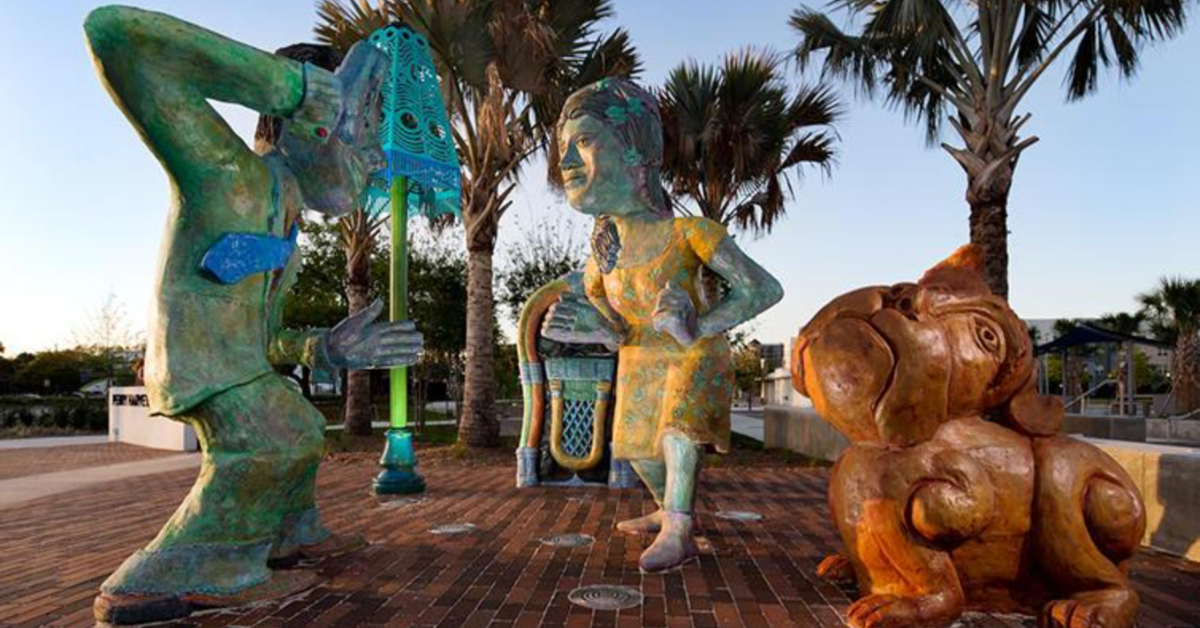
New installations and murals across Tampa are reshaping how culture is experienced—moving beyond institutions and into the rhythm of everyday life.
There are cities that contain culture, and there are those that allow it to move freely. Tampa is increasingly becoming the latter. Through a growing network of public art installations along the Riverwalk and throughout downtown, the city is redefining where—and how—art is encountered.
This is not a single exhibition with an opening night or closing date. It is an ongoing expansion—sculptures placed along pedestrian corridors, murals integrated into urban architecture, and installations that respond directly to the surrounding environment. The result is a cultural landscape that unfolds in motion, experienced not by appointment, but by presence.
Along the Riverwalk, works are positioned within one of the city’s most active public spaces. The waterfront becomes more than a backdrop—it becomes part of the experience itself. Art intersects with walking paths, gathering spaces, and daily routines, creating moments of discovery that feel unstructured but intentional.
Downtown, murals and site-specific works bring a different kind of energy. Here, scale and visibility matter. Buildings become canvases. Intersections become points of cultural expression. The city’s visual identity begins to take shape not through branding, but through accumulation—layered contributions from artists working across styles and mediums.
What distinguishes this expansion is not just the volume of work, but the shift in access. Public art removes the threshold that often defines traditional cultural spaces. There is no entry point, no ticket, no defined audience. The work exists within reach—equally available to residents, visitors, and those who encounter it unexpectedly.
That accessibility aligns with a broader movement across cultural ecosystems: the recognition that participation is not built through exclusivity, but through integration. When art is embedded within daily life, it becomes part of how a city is experienced—not an addition to it.
It also changes the relationship between audience and artwork. In a gallery, time is intentional. In public space, it is fluid. A sculpture may be passed dozens of times before it is fully seen. A mural may shift in meaning depending on time of day, light, or context. The engagement is less controlled, but often more sustained.
For Tampa, this approach signals a long-term investment in cultural infrastructure—not just through institutions, but through the city itself as a platform. It positions public space as a site of creative expression, where art contributes to identity, memory, and shared experience.
In that sense, the expansion is not just about placing works—it is about building a cultural environment. One that does not ask people to seek it out, but instead meets them where they already are.
Similar Posts
Dior and SCAD: Inside a Rare Collaboration Between Fashion House and Art School
Balloon Museum Expands Its Global Tour With POP AIR – Art Is Inflatable
A love letter in couture: Dolce&Gabbana at ICA Miami
When the Body Carries the Argument: What Makes a Dance Performance Great
The Joy of Sitting in the Front Row at a Small Theater
The Unspoken Magic of Opening Nights
10 Cities That Belong on Every Cultural Traveler’s Bucket List

Funding the Arts at Home, Pulling Back Abroad
Artists Are Not Being Replaced by AI—And the Fear Misses the Deeper Truth
New World School of the Arts Alum Leonardo Castañeda Selected for the 2026 Whitney Biennial
Crossroads of Culture: Highlights from Art Basel Miami Beach 2025