
The Best Pottery Classes in Miami: Inside the City’s Growing Clay Community
From first spins at the wheel to weekly studio rituals, Miami’s pottery scene offers far more than a one-night craft class.
By CultureOwl Editorial
There is something unexpectedly satisfying about turning a lump of clay into an object that did not exist two hours earlier—even when the finished bowl leans slightly to one side.
That feeling is drawing more people into Miami’s pottery studios. Some come looking for an unusual date night, a birthday activity or a reason to put their phones away for an evening. Others take one class and quickly begin searching for weekly instruction, open-studio time and a community of people who understand why an entire conversation can revolve around glazes, kilns and whether a piece survived its firing.
Miami now has places for both kinds of curiosity. There are relaxed beginner sessions where an instructor guides your hands through the first awkward minutes at the wheel, structured courses where students return each week to develop real technique, and shared studios where experienced potters keep works in progress on their own shelves and settle into a regular creative rhythm.
The differences are not always obvious from a booking page. A studio offering a two-hour class may be built primarily around dates and group outings, while another uses beginner workshops as the entrance to a much deeper ceramics program. Some focus on wheel throwing. Others give hand-building, sculpture or surface design equal attention. Firing may be included, limited to one piece or charged separately.
CultureOwl looked beyond the standard class descriptions to understand how each studio fits into Miami’s ceramics community: what happens during the experience, whether there is somewhere to continue after the first visit and what practical details are worth knowing before you book.
Come once to make a mug. Return because you found the place where you want to spend Tuesday nights.
Prices, programs and policies were checked in July 2026 and may change.
Inside Miami’s Pottery Scene
“Pottery classes” covers several very different experiences in Miami.
You can try a wheel once without making a larger commitment, join a multiweek course, build a piece entirely by hand, book a pottery date, attend a clay social or join a studio where you can work independently.
The city’s ceramics community includes:
One-time wheel-throwing and hand-building classes
Weekly and multiweek courses
Pottery dates and private group workshops
Membership studios with recurring access
Open-studio hours for independent potters
Kiln and firing services
Visiting-artist workshops and specialty techniques
Ceramics exhibitions, studio sales and local artist markets
The ten studios below are not ranked. Each offers a different route into working with clay and becoming part of Miami’s growing ceramics community.
10 Miami Pottery Studios to Know
Anhinga Clay Studios
People looking for a real first wheel class—not pottery painting or decorating something that has already been made—often end up at Anhinga.
The one-time class gets students onto the wheel quickly. Beginners learn how to center clay, open it and begin pulling it into small bowls or vessels. The studio says students typically create three pots during the session and select their strongest piece for glazing and firing. Additional pieces can be kept for an added fee.
That is an important distinction. Making three attempts does not necessarily mean taking home three finished pieces, and it is one of the details first-time students often miss when comparing class prices.
The current $65 session includes clay, a choice of glaze and firing for one piece. Completed pottery takes at least two weeks, and Anhinga does not send pickup reminders; students are expected to return during business hours once the processing period has passed.
The beginner class is only one entrance into the studio. Anhinga also offers five-week courses that combine wheel throwing, hand-building, glazing and selected open-studio hours. Students receive 25 pounds of clay, use of studio glazes and firing for work made during the course. Beginners learn foundational forms, while returning students can move into more complicated shapes and surface treatments.
Family programs, children’s classes, meditation-and-clay sessions, portfolio development and specialty workshops give the calendar more depth than a studio built entirely around one-time outings.
The Bird Road-area location is practical rather than polished. People generally come specifically for the class, although the studio is close to breweries and long-standing local restaurants. Parking is also easier than at many studios closer to Wynwood or Downtown Miami.
Neighborhood: Glenvar Heights/Bird Road area
Address: 4600 SW 75 Avenue, Unit C, Miami, FL 33155
Offerings: One-time wheel throwing, one-time hand-building, five-week courses, family sessions, children’s classes, meditation with clay, portfolio development, private events and specialty workshops
Price snapshot: $65 for the one-time wheel class; $250–$300 for the five-week pottery course
Membership or open studio: Selected open-studio hours are included with longer courses
Instagram: @anhingaclay
Before booking: Arrive before the demonstration begins and decide how many pieces you are willing to pay to have fired. Anhinga includes one finished piece in the base price.
Ceramic League of Miami
When Miami potters are asked where to find the city’s more established ceramics community, the Ceramic League comes up repeatedly.
The League is a nonprofit ceramics institution rather than a commercial studio built mainly around drop-in entertainment. Classes, memberships, exhibitions, workshops and member participation all contribute to how the organization operates. Its address in South Dade has become one of Miami’s long-standing points of entry for people who want to study ceramics beyond a single introductory class.
The class calendar can include wheel throwing, hand-building, surface decoration, youth programs and specialty techniques. Some sessions welcome beginners. Others assume that students already know how to center clay, use studio equipment or work independently.
That means the prerequisites matter here. Someone looking for a spontaneous two-hour date may find an easier booking process elsewhere. Someone who wants to understand glazing, firing, surface development and the discipline of making ceramics over time will find much more to explore.
The League’s policies reflect that structured approach. Courses are scheduled sessions rather than flexible drop-ins, and missed classes generally are not replaced with make-up hours or prorated refunds.
The community extends beyond instruction. Exhibitions, visiting-artist workshops, member activity and specialty firings allow students to see how other ceramicists develop their work. The studio is also a place where the difference between taking a pottery class and maintaining a ceramics practice becomes clear: regular potters need equipment, firing knowledge, storage, shared rules and people willing to keep the studio running.
Neighborhood: Kendall/South Dade
Address: 8873 SW 129th Street, Miami, FL 33176
Offerings: Wheel throwing, hand-building, surface decoration, adult and youth courses, private instruction, specialty workshops, exhibitions and member programming
Price snapshot: Varies by course, instructor and session
Membership or open studio: Yes, through the nonprofit membership and studio structure
Instagram: @ceramicleagueofmiami
Before booking: Read the prerequisites and attendance policy carefully. Many offerings are progressive courses rather than casual one-time workshops.
Gumbo Limbo Pottery
Gumbo Limbo is part teaching studio, part community workspace and part gallery of locally made ceramics.
The Kendall studio offers wheel throwing and hand-building for adults and children, along with private lessons, clay dates, parties and group experiences. It also displays work by Miami ceramic artists working across materials and processes that include stoneware, porcelain, raku and earthenware.
For people who are curious but not ready to enroll in a longer program, Gumbo Limbo offers one-time introductory sessions. Those classes provide enough instruction to understand the basic process without requiring students to sign up for several weeks in advance.
The longer courses provide a clearer sense of how pottery develops through repetition. The current six-week adult course includes twelve hours of instruction, up to 25 pounds of clay, studio glazes, tools and firing. Students can work on the wheel or explore hand-building before glazing their work near the end of the course.
What makes Gumbo Limbo especially useful is what happens after those classes.
Its open-studio membership is designed for intermediate and advanced ceramicists who are comfortable working independently. Members receive scheduled access to the studio, personal shelf space, a monthly bag of clay and firing and glazing for work made with that clay. A staff member is present for questions, but the hours are intended for independent work rather than another instructor-led class.
That solves one of the problems people discover after becoming interested in pottery: wheels, kilns, clay storage and shelves for unfinished work are difficult to recreate at home.
Gumbo Limbo’s regular hours also shift around classes and appointments, so it is worth confirming before arriving simply to browse the gallery or ask about a program.
Neighborhood: Kendall
Address: 14291 SW 120th Street, Suite 101, Miami, FL 33186
Offerings: One-time wheel and hand-building classes, six-week adult courses, youth programs, private lessons, clay dates, parties, visiting-artist workshops, firing services and a ceramics gallery
Price snapshot: $300 for the current six-week adult course; $175 per month for open studio
Membership or open studio: Yes, for experienced potters who can work independently
Instagram: @gumbolimbopottery
Before booking: Classes are often scheduled around appointments and course times. Ask whether painting, glazing and firing are included in the particular experience you select.
Pottery Studio 1
Pottery Studio 1 is organized around convenience. Classes run daily, there is no membership requirement and most participants arrive without previous pottery experience.
The standard two-hour session combines wheel throwing with hand-building. Students may create bowls, mugs, vases, candleholders or other small objects, with the final number depending on how quickly they work and how complicated their ideas become. The studio says most participants complete one or two pieces, although some may make as many as three.
The booking options are built around different outcomes.
The current $90 class includes clay, tools and firing for a decorative white-clay piece. The $130 pottery-and-painting version adds colored finishes, glazing and a second firing so the completed work can function as household tableware.
That difference is easy to miss when comparing prices. A fired decorative piece and a glazed mug intended to hold coffee are not the same finished product, even though both begin with the same lump of clay.
The studio has also developed pottery as a full social category. Couples can reserve a private date package, while larger groups can arrange birthdays, bachelorette parties, school visits and corporate events. Children as young as three can participate, and class sizes can range from an individual booking to a group of approximately 20.
This is primarily an experience-led studio rather than an obvious route into independent open-studio practice. That is not necessarily a drawback. Sometimes the goal is to plan a creative evening without navigating applications, course prerequisites or membership rules.
The practical challenge is parking. The studio warns that nearby parking is limited to two hours and that its single designated space may already be occupied.
Neighborhood: Wynwood area
Address: 164 NW 20th Street, Miami, FL 33127
Offerings: Daily wheel and hand-building classes, pottery with painting, couples packages, children’s sessions, birthdays, private parties, school trips and corporate events
Price snapshot: $90 for the standard class; $130 with painting and glazing; couples packages from $200
Membership or open studio: Not currently the studio’s primary model
Instagram: @pottery_miami
Before booking: Decide whether you want a decorative white-clay piece or a painted and glazed piece designed for everyday use. Pottery Studio 1 and Pottery-Miami refer to the same Miami operation.
Clay with Love
Clay with Love gives Miami Beach residents something that is surprisingly difficult to find: a neighborhood pottery studio that supports both scheduled classes and regular independent practice.
The studio was founded by Avigayil after she moved to Miami Beach and struggled to find the kind of ceramics space she wanted nearby. Its North Beach location now offers adult wheel and hand-building classes, children’s programs, private sessions and membership access.
Adult classes are scheduled throughout the week. Open-wheel sessions welcome beginner and intermediate students, while a separate hand-building class focuses on shaping clay without the wheel. Class packages are available for people who plan to return regularly rather than booking one session at a time.
The studio is candid about how its group classes work. They are not designed to provide continuous one-on-one instruction, and larger groups looking for individualized attention are encouraged to arrange private sessions instead. That is useful information for beginners deciding whether they would feel comfortable learning alongside returning students.
Clay with Love also operates a $220 monthly membership for adults who have taken several classes and received approval to work more independently. Membership includes studio access, shelf space, community tools, wheels, hand-building tables, glazes and a monthly firing allowance. Clay itself is purchased separately.
The most important practical detail is the firing timeline. Clay with Love asks students to allow seven to eight weeks for completed work and provides a ten-day pickup window after notification. It also clearly explains that pieces can crack or fail during firing and that finished glaze results are never completely guaranteed.
That may sound less romantic than the booking page, but it is honest pottery information. Kilns introduce heat, chemistry and unpredictability into the process. Even experienced potters sometimes open a firing to find that the clay made its own decisions.
Neighborhood: North Beach
Address: 1218 Normandy Drive, Miami Beach, FL 33141
Offerings: Adult wheel classes, hand-building, children’s classes, private instruction, dates, parties, family sessions and studio membership
Price snapshot: Four adult classes for $280; six-class and ten-class packages are also available; membership is $220 per month
Membership or open studio: Yes, following several classes and studio approval
Instagram: @claywithlove.miami
Before booking: Expect a longer firing timeline than at many other studios. Clay with Love currently advises allowing seven to eight weeks before pickup.
Roots Miami
Roots Miami sits at the intersection of ceramics, food and functional design.
Founder Darcy Williams creates handmade stoneware for homes, restaurants, cafés and coffee shops. Plates, serving pieces, espresso cups, matcha sets and other vessels are designed not simply as decorative objects but as part of how food and drink are experienced.
That restaurant connection gives the classes a different point of view. Students are learning in a working ceramicist’s studio where the surrounding conversation includes proportion, functionality, durability and how a handmade object feels when used every day.
Roots offers small-group instruction and private hand-building sessions inside ArtHood 56. Its four-week course is limited to a small number of participants, while private sessions give beginners or returning students two hours of personalized instruction. Clay, glazes and professional firing are included in the private session.
The emphasis is primarily on hand-building rather than the instant drama of the wheel. Students shape clay through slabs, coils, pinching and tools, which allows more freedom to make irregular vessels and sculptural forms.
That can appeal to people who feel intimidated by wheel throwing or who already know they are more interested in building a specific object than attempting to master centering during their first visit.
Roots also participates in local markets, offering another way to encounter the work before booking a class. Seeing the finished ceramics can help students understand the studio’s visual language and the kinds of functional pieces that influence its teaching.
Neighborhood: Model City/Liberty City area
Address: 5600 NW 7th Avenue, Unit 22, Miami, FL 33127
Offerings: Private hand-building sessions, small-group courses, custom ceramics, restaurant collaborations, commissions and local market appearances
Price snapshot: Private two-hour hand-building sessions start at $100
Membership or open studio: Not currently presented as a traditional open-studio membership
Instagram: @rootspotterymiami
Before booking: Roots is more intimate and appointment-driven than a high-volume class studio. Review the available class dates rather than assuming daily drop-in sessions.
El Studio by OCISLY Ceramics
OCISLY began with pottery in a home studio, lost that permanent space and spent a year turning restaurants, bars, hotels, museums and parks into temporary places to make art.
In 2025, founders Cristina and Adam opened El Studio in Morningside, giving that roaming community a permanent home. The result still feels influenced by the pop-up years: the calendar moves between beginner wheel classes, Art Café sessions, clay socials, artist exhibitions, themed workshops and collaborations elsewhere in the city.
The beginner wheel class introduces clay, centering and simple forms such as bowls and small vases. Students receive more than three pounds of clay and generally have time for two or three attempts. Firing is optional and currently costs $10 per selected piece.
That optional firing model makes sense for someone who mainly wants to experience the wheel. It also means the advertised class price is not necessarily the final cost for someone hoping to collect several completed pieces.
El Studio’s Art Café provides a looser experience. Participants choose from available creative materials and work at their own pace rather than following a single pottery lesson from beginning to end. The studio also runs clay socials and off-site events in other Miami spaces.
For people who want to return regularly, OCISLY offers a ceramics membership with access to wheels, hand-building tables, a slab roller, tools, shelf space, clay and scheduled firing. Weekly instructor office hours give members somewhere to ask questions while continuing to work more independently.
The studio’s language about being a “third space” is not merely branding. Its schedule is built around the idea that people may be looking for somewhere between home, work and a conventional night out—a place to make things, meet people and develop a recurring creative habit.
Neighborhood: Morningside
Address: 5400 NE 4th Court, Miami, FL 33137
Offerings: Beginner wheel throwing, Art Café, hand-building, clay socials, multiweek workshops, exhibitions, pop-ups, private events and ceramics membership
Price snapshot: Beginner wheel classes are generally around $100, with firing charged separately; event prices vary
Membership or open studio: Yes, through the Ceramicists membership program
Instagram: @ocisly_ceramics and @elstudio.miami
Before booking: Read each listing closely. The class format, firing cost, location and cancellation terms can differ between studio workshops, Art Café sessions and off-site events.
Mercy Pottery
Mercy Pottery grew from founder Mercedes Gavazzi’s own experience of moving to Miami, taking pottery classes and becoming increasingly attached to working with clay.
That personal path still shapes the studio. Mercy describes its purpose as building a community that encourages artistic growth, and its programming moves between first-time instruction, family sessions, hand-building courses and recurring memberships for more experienced potters.
The current single wheel class costs $95. Students receive instruction in the basic wheel process without enrolling in a longer course first. Family Time sessions provide a separate shared experience, while the longer hand-building workshop gives participants several weeks to explore forms that do not depend on the wheel.
Mercy’s memberships are not completely unrestricted open studio. They operate through scheduled two-hour sessions in which experienced potters bring their own project ideas and can continue learning with instructors nearby.
Current plans provide eight or twelve sessions per month. Materials and tools are included, although additional firing charges may apply depending on kiln space and frequency. Unused sessions expire at the end of the monthly cycle.
That guided structure may suit someone who is ready to work more independently but does not want to be left entirely alone with a difficult project. It also creates more continuity between instruction and personal studio practice.
Mercy is located inside Miami Ironside, a creative complex of studios, design businesses and shaded courtyards. The location gives a pottery visit a different rhythm from walking into a storefront on a busy commercial block.
Neighborhood: Miami Ironside/Upper Eastside
Address: 7580 NE 4th Court, Suite 108, Miami, FL 33138
Offerings: Single wheel classes, hand-building workshops, family sessions, private events, commissions and guided monthly memberships
Price snapshot: $95 for a single wheel class; $75 for Family Time; memberships currently range from $360 to $420 per month
Membership or open studio: Yes, through scheduled memberships for experienced potters
Instagram: @mercy.pottery
Before booking: Membership sessions do not roll over, and firing charges may be added depending on kiln use.
Atelier Ceramic Studio
Atelier approaches ceramics through a combination of technique, design and ritual.
The studio’s beginner wheel class is limited to six participants. That small capacity makes a practical difference: wheel throwing requires frequent correction during the first session, and a smaller class gives the instructor more opportunity to notice when someone’s clay is about to collapse.
The current $85 class includes guided instruction, clay, tools, studio use, bisque firing, glaze firing and refreshments. Students learn how to center, open and pull the walls of a basic vessel, while the studio handles the finishing process afterward.
Atelier also gives hand-building a central role. Its longer courses teach pinching, coiling, slab construction, surface design and finishing. Parent-and-child programs and youth courses use the same techniques in formats designed around different ages.
The studio’s Ceramic Ceremony moves deliberately away from the format of a conventional pottery lesson. The session combines clay with journaling, guided reflection, tea, wine and a grounding exercise before participants begin hand-building their pieces. Atelier explicitly describes it as an intentional creative gathering rather than a class built around technical mastery.
That distinction matters. Someone who wants detailed wheel instruction and someone who wants a reflective night working by hand are searching for different experiences, even if both type “pottery classes in Miami” into Google.
Finished work is generally ready within two to three weeks. Free parking is available behind the studio, and many class tickets are nonrefundable but can be transferred to another participant.
Neighborhood: MiMo/Upper Eastside
Address: 753 NE 79th Street, Unit 761, Miami, FL 33138
Offerings: Beginner wheel throwing, hand-building, multiweek courses, Ceramic Ceremony gatherings, pottery painting, parent-and-child sessions, youth programs and private experiences
Price snapshot: $85 for the beginner wheel class; $95 for Ceramic Ceremony; longer courses vary
Membership or open studio: Continuing courses and memberships may be offered; confirm current availability
Instagram: @almostbasicatelier
Before booking: Read the individual event description. A technical wheel class, a hand-building course and a wellness-centered Ceramic Ceremony are intentionally different experiences.
Miami Industrial Arts
Miami Industrial Arts does not operate like a conventional pottery school, which is precisely why it belongs in a guide to Miami’s wider ceramics community.
The Hialeah makerspace brings ceramics together with woodworking, electronics, laser cutting and other forms of fabrication. Its ceramics area includes pottery wheels, kilns and tools, while the larger space is designed for people who want access to equipment and a community of makers across several disciplines.
Membership currently costs $75 per month and includes access to the broader makerspace. Limited storage is available, and artists can also arrange to host workshops or classes in the facility.
This is not the most obvious place to book a polished first-date pottery class. It is more useful to someone who already has a project in mind, wants to work independently or likes moving between clay, wood and other materials.
The cross-disciplinary environment is the point. A ceramicist may share the space with furniture makers, designers, engineers and people experimenting with tools they have never used before.
The official website describes the ceramics equipment more clearly than the current instruction schedule. Anyone joining specifically for pottery should speak directly with the makerspace about orientation, kiln procedures, clay rules and when the ceramics area is available.
Neighborhood: Leah Arts District, Hialeah
Address: 1475 E 11th Avenue, Hialeah, FL 33010
Offerings: Pottery wheels, kilns, ceramics tools, makerspace membership, woodworking, electronics, laser cutting and member-led workshops
Price snapshot: $75 per month, with a discount for annual membership
Membership or open studio: Yes, through the broader makerspace
Instagram: No verified active Instagram handle was listed on the official site at the time of research
Before booking: Call before joining specifically for ceramics. Confirm current instruction, safety orientation, firing procedures and equipment access.
New Pottery Studios in Miami in 2026
Casa Terra
Casa Terra is one of the most interesting additions to Miami’s pottery scene in 2026 because it is treating ceramics as a social connector, not merely a class format.
Its early programming has included matcha-bowl workshops and collaborative gatherings with local partners such as Studio 24 Coffee and Thursday Miami. The clay project gives people something to focus on, but the larger idea is to make meeting others feel more natural than standing in a crowded bar trying to begin a conversation.
That makes Casa Terra especially relevant to Midtown, where people may be looking for creative experiences that fit into the neighborhood’s mix of residential buildings, cafés, restaurants and social events.
A matcha-bowl workshop also connects the making process to what happens afterward. Participants are not simply producing a generic practice object. They are creating something tied to a daily ritual—and potentially returning for another gathering with the same people who were working beside them.
Casa Terra’s broader model is membership-oriented. Current plans include weekly access, twice-weekly access and an all-access option with 24-hour studio availability. Depending on the plan, benefits can include clay, kiln firing, wheels, glazes, tools, storage and access to a members’ community.
The studio describes itself as a third space between work and home. Its combination of pottery, wellness, social events and collaborations suggests that community-building will be as important as technical instruction.
Neighborhood: Midtown Miami
Address: Inside HGAB Studios, 46 NW 36th Street, Miami, FL 33127
Offerings: Matcha-bowl workshops, wheel use, hand-building, glazing, firing, social gatherings, singles events, collaborative programming and studio memberships
Price snapshot: Memberships currently begin at $175 per month; availability and event prices vary
Membership or open studio: Yes, including weekly and extended-access options
Instagram: @casaterramiami
Before booking: Check the individual event location and format. Collaborative gatherings may have different partners, inclusions and schedules from regular studio access.
Family-Friendly Clay Studios Worth Knowing
Not every family searching for pottery classes wants a wheel-throwing lesson. Younger children may have more fun modeling characters by hand or painting a ceramic piece that has already been formed.
These Miami-area studios offer easier entry points for families, birthday groups and children who want the clay experience without the technical demands of centering a spinning ball of clay.
Clay World Studio
Clay World is built primarily around children and the imaginative possibilities of clay rather than traditional wheel throwing.
Classes use clay modeling, clay animation and themed projects to help children develop fine motor skills and creative confidence. The emphasis is on constructing characters, animals, miniature worlds and other playful forms—not producing a perfectly symmetrical bowl.
That distinction makes Clay World especially relevant for younger children who may not yet have the patience, hand strength or coordination required for the pottery wheel. Projects are guided step by step, but children still make decisions about characters, colors and the stories behind what they create.
The Miami Beach studio offers one-time workshops, weekly programs, after-school classes, camps and birthday parties. Workshops generally last 60 to 90 minutes, while continuing classes allow children to take on larger and more detailed projects over time. Programs are designed for children ages four and older, and all materials are provided.
Clay World is not a conventional ceramics studio with kilns, glazes and open-studio memberships. It belongs in this guide because families searching for “pottery classes for kids in Miami” may actually be looking for exactly this kind of tactile, imaginative clay experience.
Neighborhood: Mid-Beach
Address: 333 W 41st Street, Suite 518, Miami Beach, FL 33140
Offerings: Clay-modeling classes, clay animation, after-school programs, camps, one-time workshops, birthday parties, school programs and take-home clay kits
Price snapshot: Varies by class, camp and event
Membership or open studio: Ongoing children’s programs rather than independent studio access
Instagram: @clayworldstudio
Before booking: These classes focus on modeling and creative projects rather than wheel throwing or traditional pottery production.
PotterMe
PotterMe removes the most difficult part of ceramics—the construction—and begins with a shelf full of ready-made pottery waiting to be painted.
Families choose an unpainted ceramic piece, select their colors and spend up to two hours decorating it with help from the studio. PotterMe then glazes and fires the work, giving children the satisfaction of taking home a finished ceramic object without asking them to master clay-building techniques during one visit.
The inventory includes pieces at different sizes and price points, so one child may choose a small figurine while another paints a bowl, vase or more elaborate object. The format also allows adults and children to work side by side without everyone needing to complete the same project.
PotterMe recommends the experience for ages five and older. Children 12 and younger must attend with an adult, and the studio offers walk-in seating, reservations and private parties. Its current studio fee includes paints, guidance, glazing and firing, while the selected pottery piece is purchased separately.
Founder Jenna Helfman is a trained artist with a background in ceramic sculpture, and PotterMe opened in Surfside in March 2024 as an independent neighborhood paint-your-own-pottery studio. It should therefore appear as a family-friendly option, not under the article’s 2026 openings section.
Neighborhood: Surfside
Address: 9484 Harding Avenue, Surfside, FL 33154
Offerings: Paint-your-own pottery, family visits, children’s activities, birthday parties, group events and independent painting sessions
Price snapshot: Ceramic pieces currently range from approximately $10 to $100, plus a $20 studio fee for adults or $16 for children 12 and younger
Membership or open studio: No; walk-ins and reservations are available
Instagram: @pottermemiami
Before booking: This is ceramic painting, not a wheel-throwing or hand-building class. Children 12 and younger must be accompanied by an adult, and groups of five or more currently incur a service charge.
What People Often Wish They Knew Before Their First Pottery Class
You may make three pieces but keep only one
Studios often describe how many attempts students can make during a class. That is not always the same as the number of pieces included for glazing and firing.
Before booking, check:
How many pieces the base price includes
Whether firing costs extra
Whether glazing is included
Whether you choose the glaze color
Whether the final piece will be decorative or food-safe
Whether painting requires a second visit
Anhinga includes finishing for one pot in its one-time class, even though students generally create three. OCISLY allows several wheel attempts but charges separately for each piece selected for firing. Pottery Studio 1 separates its decorative class from the package that includes painting, glazing and a second firing.
Your pottery will not come home with you that day
The piece at the end of class is still wet clay.
It must dry slowly before its first kiln firing. It may then be glazed and fired again before it is ready to use or display.
Pickup timelines vary considerably. Some Miami studios estimate approximately two weeks. Atelier generally lists two to three weeks. OCISLY may require several more weeks, while Clay with Love currently advises students to allow seven to eight weeks.
Pay attention to how the studio provides pickup notifications and how long it holds unclaimed work. Shelves fill quickly, and most studios cannot store forgotten pottery indefinitely.
Wheel throwing and hand-building are different experiences
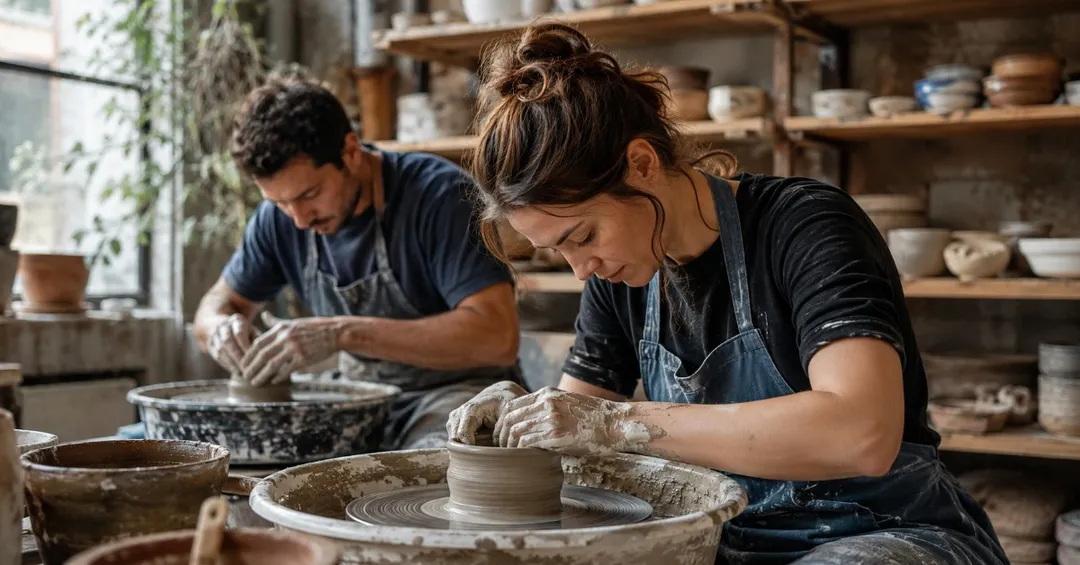
Wheel throwing is the process most people recognize. Clay spins while the potter tries to center it, open it and pull it into a symmetrical form.
It can be deeply satisfying, but it is also technical. A bowl may look stable until one misplaced finger transforms it into a soft spiral.
Hand-building removes the wheel. Clay is shaped through slabs, coils, pinching and tools, allowing people to create sculptural forms, irregular vessels, planters, tiles and objects that were never meant to be perfectly round.
Neither is the “real” or advanced version of the other. Experienced ceramic artists frequently use both.
Long nails make wheel throwing harder
Working on the wheel requires the sides and tips of the fingers to move smoothly against the clay. Long nails can dig into the surface, catch on the rim or make it more difficult to shape the interior of a small vessel.
Studios commonly recommend trimming long nails before class. Wear clothing and closed-toe shoes that can handle clay and water, remove rings and bracelets, and tie back long hair.
Clay generally washes out, but a first wheel class is not the evening to test that theory with a favorite silk blouse.
One class is enough to become curious, not proficient
A one-time class can teach you whether you enjoy working with clay. It rarely provides enough repetition to become comfortable with the wheel.
Continuing requires:
Repeated instruction
Time to practice
Space for unfinished work
Tools and clay
Glazes
Access to a kiln
People who can explain what went wrong
That is why the distinction between a one-time experience and a studio community matters.
A pottery date may be the right way to spend one evening. A multiweek course may become the beginning of a skill. A membership may eventually become the place where you see the same people every week, recognize their work on the shelves and begin measuring time by kiln firings.
Frequently Asked Questions
How much does a pottery class cost in Miami?
One-time beginner pottery classes in Miami generally start around $65 and can exceed $100 per person, depending on class length, group size, glazing, firing and whether the experience is private. Couples packages and specialty workshops usually cost more. Always check how many finished pieces are included before comparing prices.
Do I need experience to take a pottery class?
No. Most one-time wheel-throwing and hand-building classes are designed for complete beginners. Multiweek intermediate courses, open studios and memberships may require previous instruction or the ability to work independently.
Are there pottery memberships and open studios in Miami?
Yes. The Ceramic League of Miami, Gumbo Limbo Pottery, Clay with Love, El Studio by OCISLY, Mercy Pottery, Casa Terra and Miami Industrial Arts offer different forms of ongoing access. Some are appropriate for recent beginners, while others require several completed courses or previous studio experience.
Are pottery classes good for dates?
Pottery works well for dates because the activity gives both people something to focus on while still leaving room for conversation. Pottery Studio 1 offers private couples packages, while Gumbo Limbo, Anhinga, OCISLY, Atelier, Casa Terra and other studios schedule social workshops or private experiences.
Can children take pottery classes in Miami?
Yes. Several Miami studios offer children’s classes, family workshops, camps and parent-and-child sessions. Age minimums and class formats vary, so families should confirm whether the activity involves wheel throwing, hand-building or painting and whether each child needs a separate ticket.
More Than a Slightly Crooked Bowl
Most people will not master pottery during their first class. They may not even make the object they imagined when they sat down at the wheel.
The useful outcome is discovering what holds their attention.
Some people become interested in the repetition and technical challenge of throwing. Others prefer building by hand, carving surfaces, testing glazes or making sculptural pieces that never touch a wheel. Some are drawn less to the finished object than to the weekly ritual of returning to the same studio and working quietly beside familiar people.
Miami’s pottery scene now has room for all of those paths: one-night experiences, progressive courses, nonprofit membership, independent workspace, intimate artist-led classes and newer gatherings where clay is simply the reason everyone showed up.
The first bowl may lean.
You may still use it every morning.